FPL
The Best FPL Forwards & Mid-Priced Defenders for 2025/26: Who to Trust?
Discover the best premium forwards and top mid-priced options in attack and defence for FPL 2025/26.


Which premium forward deserves your armband? Is there a reliable mid-priced gem who could free up cash for your midfield? And with the new defensive contributions, are those £5.0m–£5.5m defenders now must-haves? Let’s break down the best picks for the 2025/26 campaign, focusing on strikers who can deliver early points and defenders who combine value with consistency.
Best Premium Forwards: 2025/26’s Heavy Hitters
Here we’re including anyone at £8.0m or higher. Here’s how the best shape up for Gameweek 1 and beyond.
Erling Haaland (£14.0m) – The Reluctant Differential?
Let’s start with the obvious: Erling Haaland. Last season, his 22 goals and three assists felt a touch underwhelming by his own sky-high standards. But make no mistake, Haaland remains the most explosive FPL asset in the game. He’s central to City’s attack, responsible for 42% of their goals when on the pitch. Even in what was seen as a “down” year, City scored the second most goals (72) and boasted an xG of 70.14.

With Rodri back, some fresh faces, and early fixtures against Wolves (A), Spurs (H), Brighton (A), United (H), and Burnley (H), Haaland could explode out of the blocks again. Right now, his ownership sits at a surprisingly low 18%. If you’re choosing between him and Salah, it’s perfectly viable to back Haaland as your one premium.
Alexander Isak (£10.5m) – The Wildcard Transfer Watch
Isak is the second-best forward in the game, and, depending on price, some argue he’s the best overall. After bagging 23 goals and six assists for Newcastle, his future is now under the microscope, with Liverpool showing strong interest.
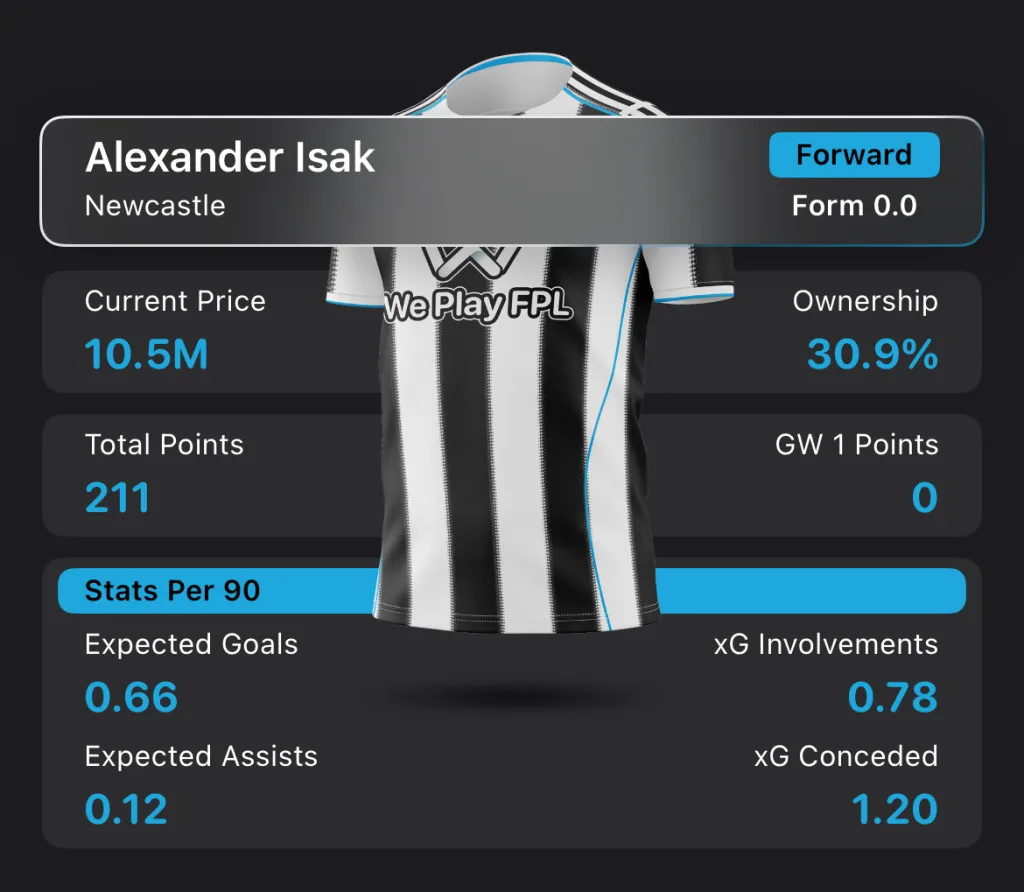
If he moves to Anfield, his appeal goes up, even if he loses penalties. The supply at Liverpool, the league’s top scorers (86 goals, 81.76 xG), would make him a massive threat. But, until his future is settled, there’s a risk. Newcastle’s opening games, Aston Villa (A) and Liverpool (H), aren’t ideal for FPL managers looking for fast starts. Monitor closely; if he moves, we’ll need to reassess Salah and the Liverpool attack as a whole.
Viktor Gyokeres (£9.0m) – The Arsenal Newcomer
Gyokeres arrives at Arsenal after a stunning spell at Sporting, where he scored 97 goals and delivered 27 assists in just 102 games. His penalty record is elite (89% conversion), and he could even challenge Saka for spot-kicks. If he claims pens, the £1.0m discount versus Saka makes him intriguing.
But there are risks: no full pre-season, Arsenal’s opening fixtures (Liverpool, City, Newcastle in first six), and competition from Kai Havertz. For now, Gyokeres is a “wait and see,” but don’t forget about him.
Ollie Watkins (£9.0m) – Mr. Reliable
Watkins has scored double-digit goals in every Premier League season he’s played. Last year, he managed 16 goals and eight assists, and he’s nailed on to start for Villa (who have a kind opening schedule). The odds say he’ll stay put, and with Villa’s great fixtures, Newcastle (H), Brentford (A), Palace (H), Sunderland (A), Fulham (H), Burnley (H) , he’s the second highest-scoring forward for the first eight. Watkins is a solid, low-risk pick.
Hugo Ekitike (£8.5m) – The Anfield Enigma
Ekitike joins Liverpool after 15 goals and eight assists at Frankfurt. He boasts excellent underlying numbers (xG 21.6, xA 6.8) and should thrive under Arne Slot. If he nails down the number nine role, surrounded by creative players like Salah and Wirtz, he could be one of the bargains of the year. The only caveat: If Isak arrives, Ekitike’s place (possibly on the left, rotating with Gakpo) becomes less certain. Watch preseason closely.
Mid-Priced Forwards: Value in Attack
Forwards between £6.5m and £7.5m are always tempting for those hunting value. This season’s best bets include proven finishers and some exciting wildcards.
- Evanilson (£7.0m, Bournemouth): Led his team for xG (12.46) and big chances. With Enes Unal injured, he’s nailed for minutes and a steady source of points, especially after the tricky GW1 at Anfield.
- Jorgen Strand Larsen (£6.5m, Wolves): Ended last season with a flurry of goals and assists, now likely to be Wolves’ main striker and possibly on penalties. Enables flexibility elsewhere.
- Chris Wood (£7.5m, Nottingham Forest): Last season’s surprise package. Nailed for minutes and pens, with a great opening run of fixtures.
- Danny Welbeck (£6.5m, Brighton): The veteran led Brighton in goals and, with Joao Pedro and Ferguson gone, should start up front and take pens.
- Dominic Solanke (£7.5m, Spurs): Nine goals and five assists in a tricky debut season at Spurs. If Son leaves, he could take pens. Spurs’ fixtures are kind and he could start strong.
Best Mid-Priced Defenders: Unlocking New Value
With the new rules rewarding clearances, blocks, interceptions, and tackles, defenders in the £5.0m–£5.5m bracket look better than ever. Here are your top picks:
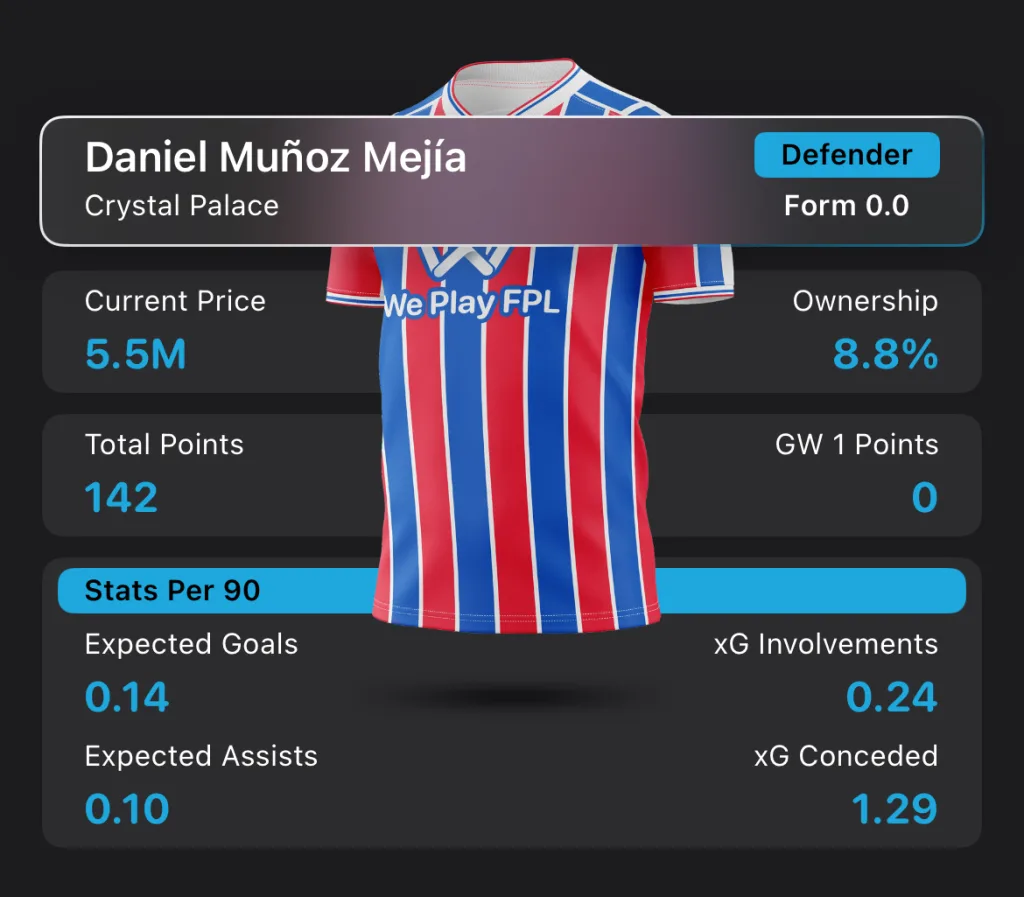
1. Daniel Muñoz (Crystal Palace, £5.0m)
A full-back who plays more like a winger. Four goals and six assists last season, plus great attacking stats. Palace’s early fixtures (Forest, Sunderland, West Ham, Everton, Bournemouth) are inviting. If you want an attacking defender who can deliver double-digit hauls, look no further.
2. Nikola Milenković (Nottingham Forest, £5.0m)
Offers a big goal threat from set-pieces. Forest’s fixtures are strong for clean sheets, and Milenković is one of the highest-scoring defenders for goals.
3. Murillo (Nottingham Forest, £5.0m)
Leading all defenders for defensive contributions and bonus points. Not a huge goal threat, but his baseline value is immense, especially with Forest’s kind opening games.
4. James Tarkowski (Everton, £5.0m)
Reliable, bonus-heavy, and a threat from set-pieces. Everton have a nice opening run, and if fit, Tarkowski offers a safe floor for points.
Building a successful FPL team is all about blending explosive premiums, value picks, and set-and-forget defenders. Whether you’re gambling on Haaland, eyeing Isak’s transfer saga, or searching for bonus magnets in defense, balance is key.
Don’t forget: For the latest transfer updates, player analysis, and predicted points, download the “We Play FPL” app! Get ahead with transfer planning, compare players side by side, and make informed decisions for a flying start to the season.
May your arrows be green. Happy managing!

Chip Strategy
GW10 Rice: is he worth a £7.4m transfer?
Rice has five assists, but his £7.4m buying case needs a closer look. Weigh his creativity, goal threat and fixtures before using a GW10 transfer.

Keep Declan Rice for Hull at home if you own him and have a more urgent transfer to make. Buying him at £7.4m needs a stronger reason than his five assists and 47 points. You would be paying for a midfielder whose creativity has produced more returns than his underlying attacking numbers suggest.
Rice can reward owners against Hull. The concern for a new buyer is the price, his limited goal threat and the fixtures that follow. Before spending a transfer, decide whether you want him beyond GW10.
Five assists need some context
Rice has five assists against 2.01 expected assists this season. He has created chances, but projecting another five assists from the same level of creation would be optimistic. Expected assists describe the chances he has created; they do not forecast his next result or require him to blank to make up the difference.
His per-90 attacking rates sharpen the buying decision: 0.05 xG/90, 0.24 xA/90 and 0.29 xGI/90. He has averaged 84.4 minutes per match. At that level of goal threat, you are relying on his creativity for much of his attacking upside. He has scored no league goals so far.
Those season-to-date performance rates help explain how he has played. They are not a points prediction for Hull, and the average playing time does not guarantee his next start or workload.
Check the floor beneath the returns
Rice has collected seven bonus points. Those points count for his owners, but you should judge the next purchase on the scoring routes available in the coming matches. Budgeting for bonus alongside each assist would overstate the security of his returns.
His 8.76 DefCon/90 also gives little reason to assume a dependable cushion of defensive-contribution points. That rate measures defensive actions across his playing time; it does not guarantee threshold points in an individual fixture. Use the verified 84.4 average minutes per match alongside it, then leave room for variation in both workload and involvement.
Rice remains capable of a useful return. At £7.4m, a buyer needs to want his creative role enough to accept the limited goal threat, rather than treating his past points as a reliable weekly floor.
Look beyond Hull at home
Arsenal host Hull in GW10, then visit Newcastle in GW11 and host Manchester City in GW12. A transfer for Hull alone leaves you with another decision at the next deadline.
If you are considering Rice, compare players and upcoming fixtures in We Play FPL before committing the budget. Check how the purchase fits your midfield through Newcastle and Manchester City, including whether you would still choose him if you could not use another transfer on that slot.
Existing owners can give him the Hull match while fixing a weaker starting position. For a fresh purchase, favour a clear improvement to your XI over chasing the assists you missed. Rice makes sense if you want his creativity across the holding period and can accept the risk of quieter weeks. His recent returns alone are too thin a reason to spend £7.4m.
Fixtures
GW10 Calvert-Lewin injury doubt: hold or move to Evanilson?
Hold Calvert-Lewin if the fitness update supports a start and your cover works. For a fresh forward purchase, we prefer Evanilson at £6.4m.
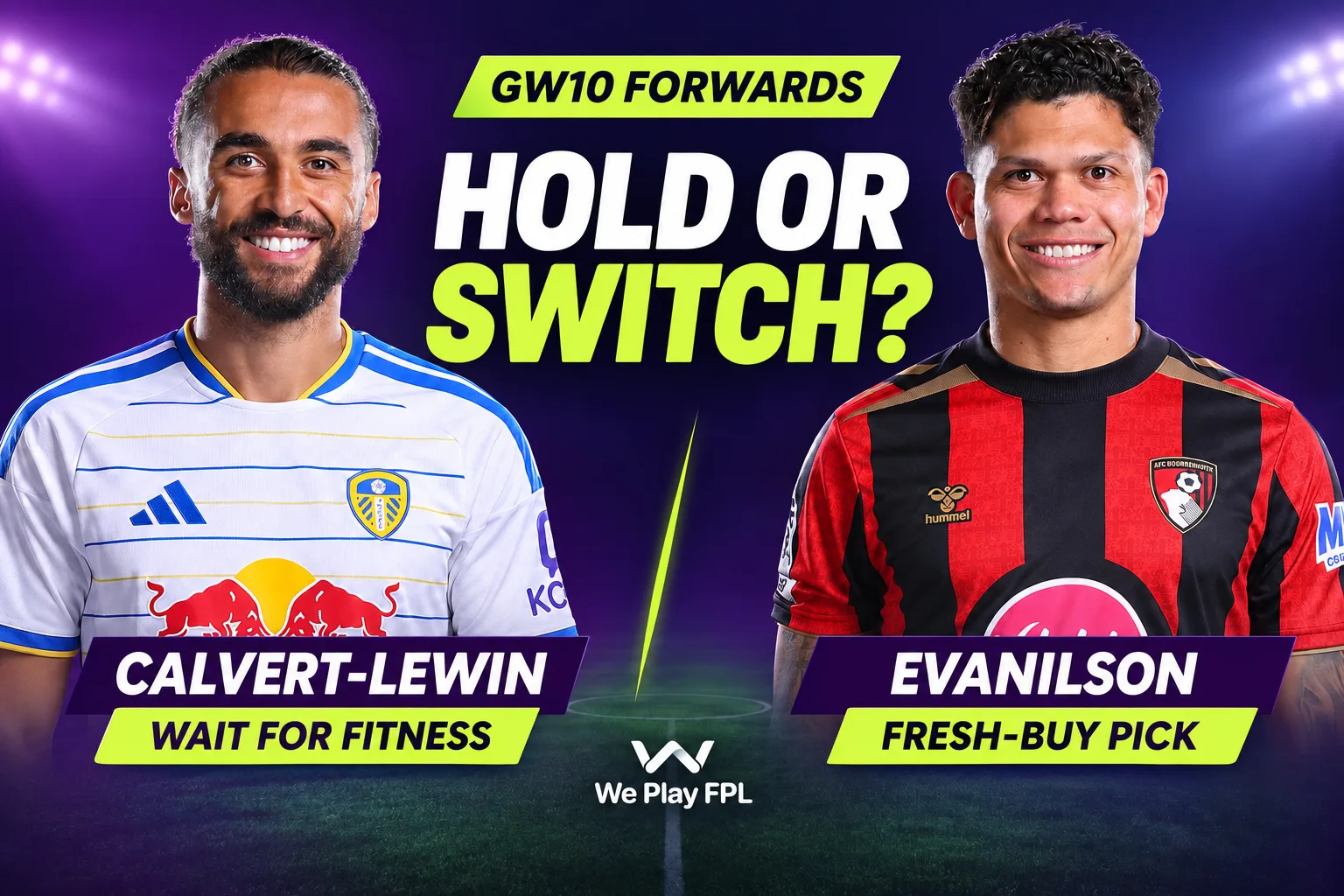
Keep Calvert-Lewin if the final fitness update supports a start and you have cover you trust. For a fresh forward purchase, we prefer Evanilson. You can buy the Bournemouth forward without taking on Calvert-Lewin’s unresolved foot problem, while an existing owner has more reason to wait before spending a transfer.
Calvert-Lewin costs £6.1m and carries a foot-injury flag ahead of Leeds’ home match against Spurs. Evanilson costs £6.4m, has no current injury flag, and visits Ipswich in GW10. That £0.3m difference is a buying-price comparison: check your own selling value before planning the switch.
Calvert-Lewin owners can wait for the fitness update
The current flag gives Calvert-Lewin a 75% chance of playing. Treat that as unresolved availability, with no guarantee of a start or a full match. Owners should wait for the final update before deciding whether their squad needs a replacement.
Leeds host Spurs in GW10, visit Chelsea in GW11, then host Coventry in GW12. You can retain Calvert-Lewin for the two home fixtures if his fitness allows it, with a separate lineup decision for Chelsea away. Selling him before the injury picture clears could mean spending a transfer on a forward you would want to start again in GW12.
Check the substitute who would cover him. A playable bench option makes a hold easier to accept, but you still face the risk of Calvert-Lewin appearing for a short spell and blocking an automatic substitution. Managers who need him to complete their XI have more reason to consider a sale if the final update leaves his participation in doubt.
Evanilson is our preference for a new purchase
Evanilson offers a route into Bournemouth’s attack at £6.4m. After Ipswich away, he faces Nottingham Forest at home in GW11 and Fulham away in GW12. A new buyer can assess that run without inheriting an injury decision before the first match.
His season-to-date attacking rate is 0.55 expected goal involvements per 90 minutes, compared with Calvert-Lewin’s 0.48 xGI/90. Evanilson averages 83.7 min/match; Calvert-Lewin averages 85.9 min/match. Those are played averages, so Calvert-Lewin’s figure does not tell you how long he will play while managing the foot problem.
The difference in xGI/90 supports a preference for Evanilson, rather than a claim that he will outscore Calvert-Lewin this week. Both forwards have offered attacking involvement. For a new purchase, we favour Evanilson’s combination of availability and the upcoming fixtures; an owner considering a sale must weigh the transfer cost too.
Check the next three lineups before switching
Compare your XI with Calvert-Lewin available, your XI with him absent, and the team you could field after buying Evanilson. You can test those future lineups in We Play FPL before using a transfer. Include the GW11 and GW12 selections so you can see whether the move improves more than the immediate injury cover.
Use the switch to solve a starting-XI problem. If a positive fitness update lets you start Calvert-Lewin with confidence, keeping him preserves a transfer for another position. If he cannot play and your substitute would leave you short, Evanilson is a sensible replacement, provided you can afford him and have room within the club limit.
Make the final call before the GW10 deadline on Friday 6 November at 18:30 UTC. Our preference is to hold a fit Calvert-Lewin as an owner and buy Evanilson for a vacant forward slot. An unresolved injury that leaves your XI exposed is the reason to turn that buying preference into a sale.
Chip Strategy
GW10 captaincy: Haaland or Gabriel for the armband?
Haaland leads our GW10 captaincy picks, with Gabriel at home to Hull the alternative. Compare their scoring routes and check Calafiori’s workload.

Haaland gets our GW10 captaincy vote away to Forest. Gabriel is a credible alternative at home to Hull for managers willing to back Arsenal’s clean-sheet prospects and his attacking threat. Choose between those routes after checking selection news, with Haaland our first choice if you own both.
Gabriel’s home fixture deserves consideration. His season-long playing time and several ways to score make him more than a punt on a header. The trade-off is the weight you place on a defender’s clean sheet against Haaland’s stronger attacking involvement.
Haaland offers the stronger attacking case
Haaland averages 88.8 min/match and records 0.74 xG/90, with 0.84 xGI/90 once expected assists are included. At £15.8m, he takes a large share of the squad budget, but owners can captain him without spending a transfer or changing their team structure.
Manchester City visit Forest in GW10. The away venue gives Gabriel’s home match some appeal, though choosing Haaland still means backing the player with the more substantial attacking record in this comparison. His goal threat is the main reason for our preference.
These rates describe season-to-date performances. A 0.84 xGI/90 figure is neither a GW10 points prediction nor a promise of a goal involvement. Use it to judge the attacking case, then check whether new fitness or selection information changes your confidence before the deadline.
Gabriel gives you a different route to returns
Gabriel costs £8.0m and averages 90.0 min/match. He has 0.80 xGC/90 and 0.19 xGI/90, including 0.16 xG/90. Against Hull at home, managers can back the combination of defensive returns and his threat from set pieces.
His 9.00 DefCon/90 adds context to the defensive case. It measures defensive contributions per 90 minutes; it does not guarantee contribution points in this match. The same caution applies to clean sheets: xGC/90 measures expected goals conceded while he is on the pitch, rather than the chance of shutting out Hull.
Gabriel’s attacking rate sits below Haaland’s. That does not settle the captaincy by itself because defenders have other scoring routes, but it explains what you accept by choosing him. You put more weight on Arsenal keeping a clean sheet and on Gabriel adding another return.
For a manager who owns Gabriel without Haaland, he is a defensible captaincy option. For an owner of both, we lean Haaland unless fresh team news changes the assessment. Keep a purchase decision separate from the armband: Gabriel’s captaincy appeal this week alone does not justify spending a transfer and £8.0m.
Check Calafiori’s workload before choosing another Arsenal captain
Calafiori shares the Hull home fixture and costs £5.9m. He records a higher attacking-involvement rate than Gabriel at 0.29 xGI/90, alongside 0.85 xGC/90 and 4.64 DefCon/90. His average playing time is lower at 77.7 min/match.
That combination makes a selection check important. Reassess his workload after the midweek match and the available information about his next start. A good fixture gives little protection from reduced playing time, and a short appearance can leave you relying on the captain you chose rather than your vice-captain.
We prefer Gabriel within this Arsenal captaincy comparison unless team news gives a reason to change. Calafiori’s stronger xGI/90 alone is insufficient to move him ahead when Gabriel has the longer played average and stronger defensive-contribution rate. Neither historical average guarantees a start this weekend.
Make the call with the players you own
You can test captains and future line-ups in the We Play FPL planner before changing your live squad. Compare the armband choices within your current team, then consider transfers as a separate decision. A captaincy change costs no transfer; buying a player for one attractive fixture can affect several later weeks.
Our order is Haaland first, Gabriel the alternative, with Calafiori requiring a closer workload and selection check. Recheck availability before the GW10 deadline on 6 November at 18:30 UTC and choose a vice-captain you expect to play.