Championship
How Wrexham’s £48m Cash Injection Reshapes January Plans and the Cherif Question
£48m injection shifts Wrexham’s January window focus amid striker interest and transfer caution soon


With under a week remaining in the January transfer window, Wrexham have received a £48 million cash injection that could alter their promotion push. Football finance expert Kieran Maguire suggests the £48 million comes from current owners Ryan Reynolds and Rob McElhenney, who purchased the club in 2020 for just £2 million. The money is thought to be for infrastructure costs and player recruitment.
Wrexham have been notably quiet in this winter window, facilitating exits such as former captain James McClean and promotion hero Elliot Lee. It is unclear whether the new funds will be used to sign a player before the deadline, but the investment offers another route for the Red Dragons to compete with the capital flowing through the biggest clubs in the Championship.
After spending around £28 million during the summer to bring in 13 new players, a quieter January was always likely. Manager Phil Parkinson reflected on that overhaul: “This summer was the biggest turnover I’ve ever been involved in as a manager,” and added, “That caused a real air of excitement. This one is slightly different in that we made those changes in the summer.” Parkinson also indicated the immediate priority is returning injured players rather than wholesale additions to the squad.
Wrexham remain in the market for a striker and have been linked with Angers forward Sidiki Cherif. According to The Athletic, Parkinson flew out to watch the 19-year-old play against Paris FC on Sunday. Angers are reportedly seeking around £19 million for Cherif, who has scored four goals in 19 Ligue 1 appearances this season. The No. 9 has been the “subject of talks” with Wrexham as the club weighs whether to pay what would be a Championship record fee for a teenager.
A new striker would address persistent scoring inconsistencies. The Red Dragons have scored more than two goals in just four of their 28 league matches this season. Kieffer Moore began well after his summer arrival, scoring four times in his first three Championship appearances, but has managed six goals in 21 league outings overall, three of which came against Coventry City alone. Without further reinforcement in January, Parkinson’s side face a tougher route to making their Premier League ambitions a reality.

Bournemouth
USMNT names set for England across the 2026-27 season
A look at the USMNT players set to feature across England’s Premier League and Championship in 2026-27.

English football has long provided a platform for leading USMNT figures, and that remains true as the 2026-27 campaign begins. A number of players who have earned call-ups in the past year will spend the season in England’s Premier League and Championship, continuing a connection that has defined several generations of American internationals.
Tyler Adams is again part of that picture. Almost eight years after leaving New York for Europe, the defensive midfielder built momentum at RB Leipzig before moving on to Leeds United. A strong first year there ended in relegation, but Bournemouth stepped in and brought him back to the top flight. After an injury disrupted his first season on the south coast, he followed with two solid years.
Haji Wright arrives at the new season with momentum of his own. After spells in Germany, the Netherlands, Denmark and Türkiye, he settled at Coventry City and delivered 17 Championship goals last season to help them reach the Premier League. At 28, and with no previous top-flight experience in England, he faces a significant test under Frank Lampard.
Chris Richards has taken a different route to prominence. After failing to establish himself early at Bayern Munich, he has become a key figure at Crystal Palace since joining in 2022. His consistency helped drive Palace through their most successful spell, with Richards playing a major part in the FA Cup and Conference League successes under Oliver Glasner.
Antonee Robinson has spent his career in England and has continued to progress at Fulham after coming through at Everton and spending time on loan at Bolton Wanderers and Wigan Athletic. His 10 assists from defence in 2024-25 underlined his influence.
Brenden Aaronson remains at Leeds after helping the club return to the Premier League in 2025, while Patrick Agyemang must recover from a long-term Achilles injury that could keep him out until 2027. Sebastian Berhalter has joined Middlesbrough from Vancouver Whitecaps, and Aidan Morris is already established there after a busy 2025-26 campaign.
Championship
Wrexham leave United friendly with clear signs of progress
Wrexham beat Manchester United 1-0 and Lewis O’Brien impressed again in a controlled, disciplined display.
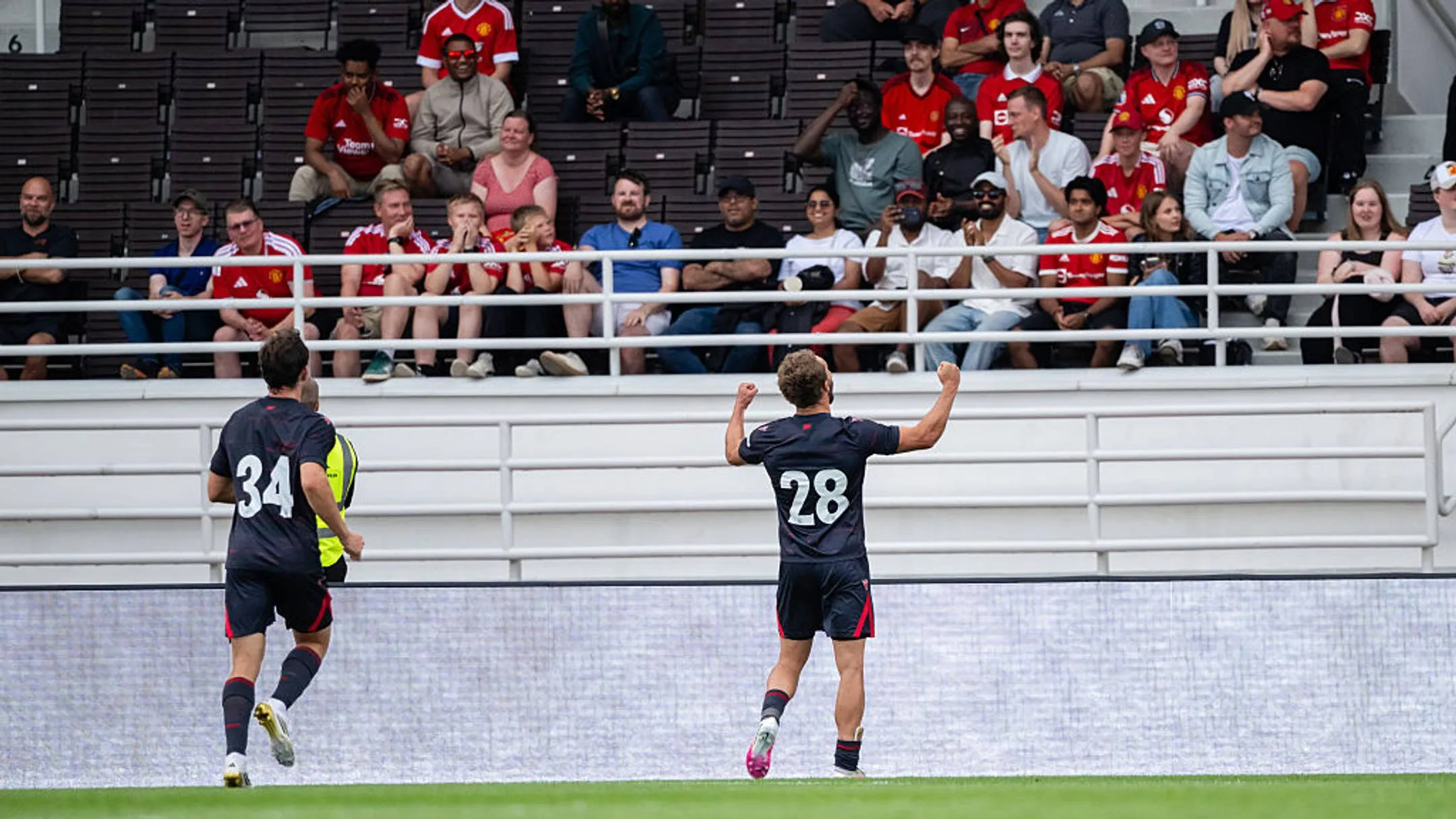
Wrexham’s second friendly of the summer ended in a 1-0 win over Manchester United, with Sam Smith scoring the only goal in the first half. It was another useful step in Phil Parkinson’s preseason work, with the squad split across two separate lineups and 22 players used as the manager continued to manage fitness levels.
The result followed last week’s goalless draw with Wisła Kraków and offered further evidence that Wrexham are already operating at a strong level before next week’s three-match U.S. tour. Parkinson has been open about using these games to build condition, but the performances have also underlined how competitive his side can be.
Against Manchester United’s senior players, Wrexham were the stronger team in the opening period. After the break, the emphasis shifted toward defensive structure as the opposition introduced a youthful side filled with academy players. That context matters, particularly with United playing their first preseason fixture and leaving out a number of World Cup stars.
Even so, Wrexham’s display was encouraging and reinforced the sense that Parkinson is content to wait on recruitment. The club may still want midfield additions, but Lewis O’Brien again looked like a player ready to make a major impact in the Championship.
Operating deeper alongside Matty James, O’Brien controlled the tempo in the first half and supplied the assist for Smith’s winner. He completed 75% of his passes in the attacking third and finished with 93% overall passing accuracy. He also won every tackle, claimed 60% of his duels, and added three recoveries and two clearances.
Smith was the stand-out from the academy-linked trio in Wrexham colours, with Ollie Rathbone and Matty James also involved. The striker’s movement and work rate unsettled Manchester United throughout the first half before he arrived unmarked at the back post to finish a move built down the left.
Wrexham remain the only Championship club yet to make a signing this summer, and Parkinson has made clear that any new arrival must represent a meaningful upgrade on the squad that finished seventh last season. Saturday’s game may have offered a few names worth considering, including Harry Amass, Toby Collyer and Shea Lacey. Amass, in particular, looks well suited to the wingback role currently viewed as the side’s biggest need.
Back-to-back clean sheets have also given Wrexham a solid base. Arthur Okonkwo’s penalty save against Wisła Kraków helped preserve the draw, while this was another disciplined team effort that kept Manchester United quiet.
Championship
Wrexham’s 10 Premier League Loan Targets to Strengthen a Championship Push
Wrexham explore Premier League loan options to strengthen squad for another Championship challenge..

Wrexham could look to the Premier League loan market this summer as part of a recruitment plan to improve their promotion prospects from the Championship. Club sources expect a more competitive division next season, and Phil Parkinson would only pursue loan signings that “add genuine quality to his first-team squad.”
Clubs must register a maximum senior squad of 25 players aged over 21, with eight homegrown players and two designated goalkeepers. Players under 21 do not need to be registered, but every loan signing must be registered regardless of age.
Awoniyi: The 28-year-old centre forward had a reduced role at Nottingham Forest, scoring four goals and one assist in 481 Premier League minutes last season, including a brace in the victory over Chelsea. He offers an efficient goals-per-minute record, but with one year left on his contract Forest may favour permanent offers.
Akpom: Now 30, Akpom joined Ipswich Town permanently last month but saw limited game time on loan from Ajax this season, scoring two goals in 31 appearances. With Ipswich promoted, significant Premier League opportunities appear unlikely and a Championship leading role could suit him.
Lacey: The 19-year-old made four first-team appearances for Manchester United across all competitions. He remains a raw talent who would seek regular minutes on loan and would likely compete with Josh Windass and Nathan Broadhead for attacking midfield positions.
Moore: Eighteen and the youngest player to appear for Tottenham Hotspur in the Premier League, Moore gained experience on loan at Rangers. A natural left winger, he would provide attacking depth and impact from the bench.
Armstrong: The 19-year-old central midfielder impressed on loan at Preston North End before returning to Everton, where he made 13 Premier League appearances. There is known interest in Armstrong this summer and another loan is a logical option.
Konak: The 20-year-old defensive midfielder is highly regarded at Brentford, has 14 senior appearances including 10 in the Premier League, and represented Türkiye at U21 level. He stood out during 16 Championship appearances for Oxford United.
Amass: A promising 19-year-old wingback, Amass impressed on loan at Sheffield Wednesday before Manchester United redirected his loan to Norwich City. He made one appearance for the Canaries before injury curtailed his season. He won Manchester United’s Young Player of the Year award in 2024–25 and has seven senior appearances for the club.
McFarlane: A 19-year-old product of New York City FC and one of the youngest MLS signees, McFarlane has been involved with England U19 and is highly regarded at Manchester City, though he lacks senior experience in English football.
Valdimarsson: The 24-year-old Iceland international has 12 senior appearances for Brentford, including three in the Premier League. He was named in the matchday squad for every senior Brentford fixture last season but sits behind Caoimhín Kelleher in the pecking order.
Vítek: A young goalkeeper who impressed on loan with Bristol City in the Championship, Vítek earned praise for his shot-stopping and is considered to have a very bright future.