Chip Strategy
FPL GW3: Hold Florian Wirtz for Liverpool’s Fixture Run
Wirtz owners should use Ipswich, Fulham and Bournemouth to test the 7.5m midfielder, then review the Liverpool pick before Man City in GW6.

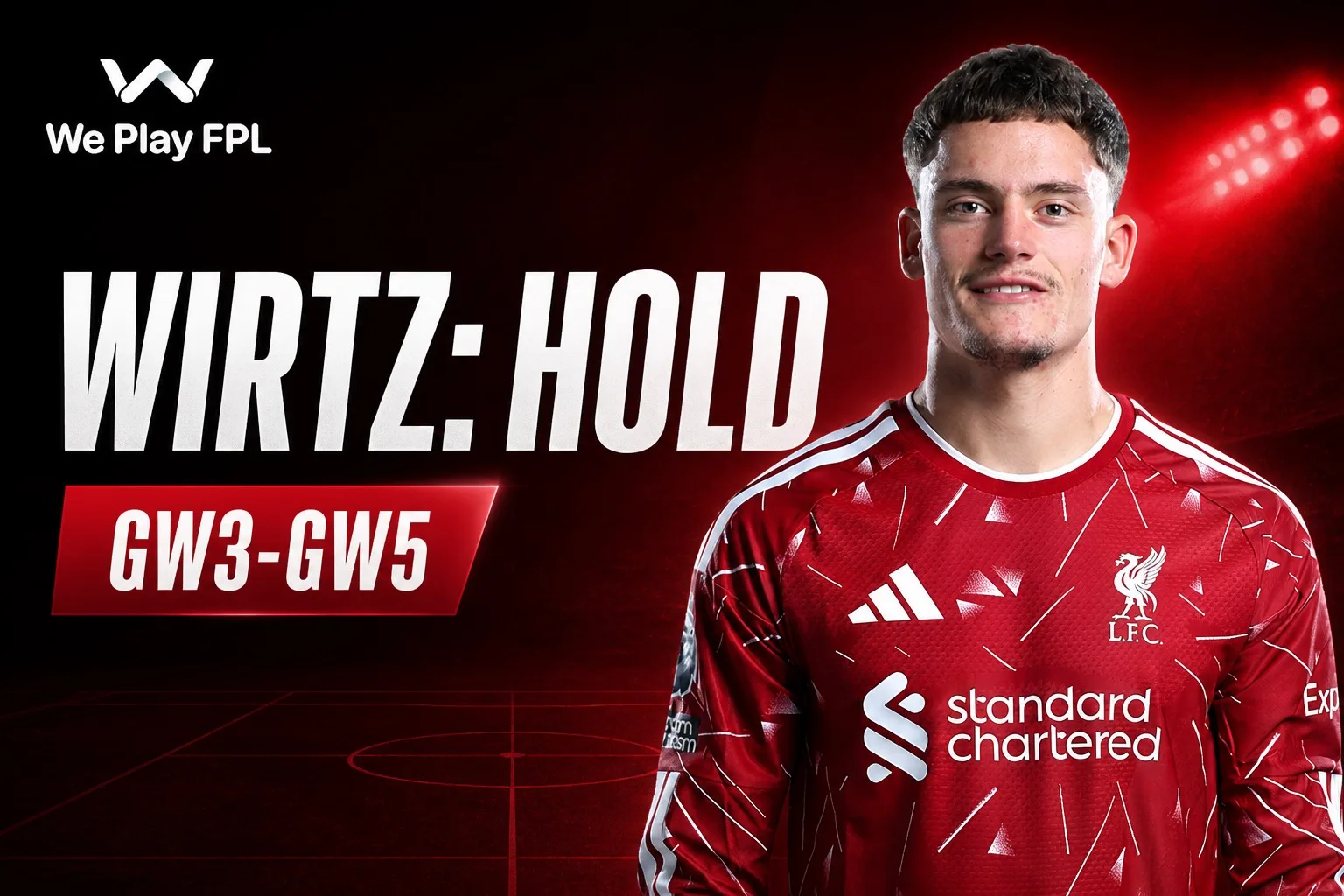
Florian Wirtz owners should hold for Gameweek 3. The Liverpool midfielder costs 7.5m, has started both league matches and has played 152 of the first 180 minutes. Six points may feel light for that investment, but Ipswich Town away starts a three-match run that gives him time to repay the pick.
Liverpool host Fulham in GW4 and visit Bournemouth in GW5. Those fixtures give owners a clear review window before Man City visit Anfield in GW6. Selling now would discard that run after two starts, so the next move needs a stronger reason than the opening score.
The fixtures buy Wirtz three more matches
Ipswich away gives Wirtz an immediate chance to turn involvement into a return. Fulham at home follows, then Liverpool travel to Bournemouth. An available Liverpool midfielder with two starts deserves that run when your squad has no injury or suspension forcing a move.
The sequence also creates a clean decision date. Hold through GW5 while Wirtz keeps his place, then review his role and output before the Man City fixture. You do not need to make a season-long call before the GW3 deadline.
This approach protects a transfer for problems that demand action. It also lets you judge Wirtz with five league line-ups instead of two. At 10.6% ownership, his score can help your rank without forcing you to treat popularity as a reason to keep or sell.
Minutes should set the sell trigger
Wirtz has started twice and logged 152 minutes. That leaves a modest substitution concern, but it does not show that he has lost his place. Owners need the next line-up and substitution pattern before turning that concern into a transfer.
Set two triggers. Reassess if Wirtz drops out of the starting XI or if early substitutions reduce his route to returns across the next matches. A fitness flag or fresh competition for his role would add weight to the sale. Keep him when he starts and stays available.
The six-point total should sit behind those role checks. Two matches cannot settle the value of a player whose next three fixtures remain usable. Managers often spend a transfer to escape a slow start, then lose the chance to act on a new injury or a clearer role change elsewhere.
Demand a full upgrade before selling
A Wirtz sale needs to improve your squad beyond one position. Compare the replacement’s expected starts, price and fixtures with what you already own. Include the use of any money released by the move.
An upgrade can make sense when it fixes two weak slots or funds a captaincy route. A sideways move between players with similar minutes risk gives you less value and uses a transfer that could carry into GW4.
Write down the evidence that would reverse the hold. A benching, reduced role, injury or confirmed alternative with stronger minutes and fixtures can do it. A single blank at Ipswich should not.
Review before GW6
Hold Wirtz for Ipswich away, Fulham at home and Bournemouth away while he remains fit and starts. Use those matches to judge his minutes and route to returns. The Man City home fixture in GW6 gives you a natural point to keep, sell or redirect the 7.5m slot.
Check Liverpool team news before the GW3 deadline. If Wirtz stays available, the fixture run supports patience.





Chip Strategy
FPL GW5: King or Calafiori for your starting XI?
Our narrow GW5 preference is King, but Calafiori’s attacking involvement and clean-sheet route keep the choice close. Check minutes and formation before benching either.
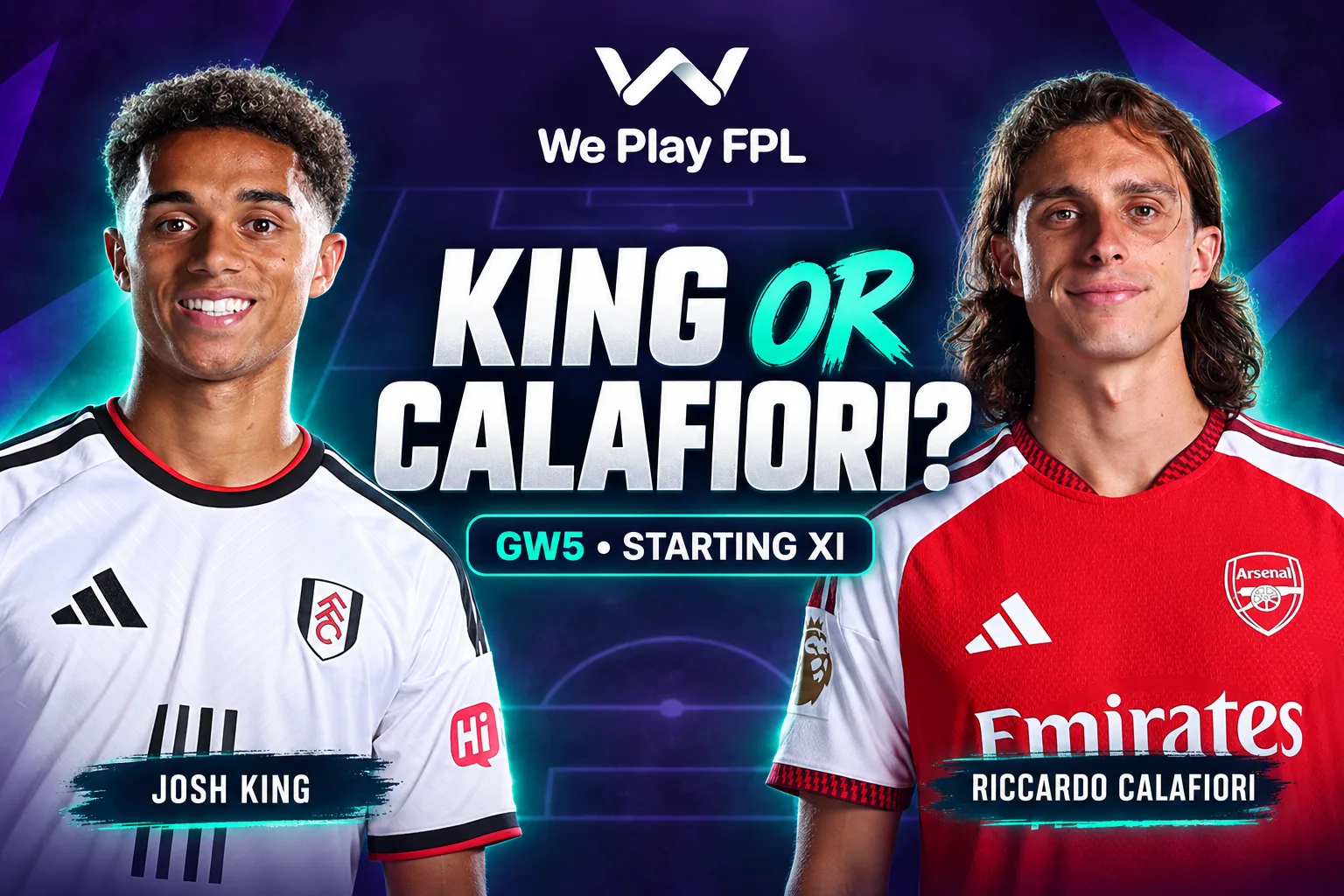
Josh King gets our narrow nod over Riccardo Calafiori for GW5 if you own both, expect both to start and can keep a legal formation. King hosts Manchester United; Calafiori travels to Brighton. You can make a case for either, so check the rest of your XI before choosing your first substitute.
King has the higher early attacking involvement rate. Calafiori offers attacking returns alongside Arsenal’s clean-sheet potential. The gap is small enough that fresh minutes news should carry more weight than a firm verdict based on four matches.
King offers the attacking edge
King has started four matches and played 346 minutes. His season-to-date expected goal involvement rate is 0.41 per 90: 0.30 xG/90 and 0.11 xA/90. At £5.5m, the Fulham midfielder has contributed through shooting as well as chance creation.
For an existing owner choosing one starter, we favour that attacking involvement at home to Manchester United. Treat it as a preference under uncertainty. Those rates describe the chances King has had and created so far; they do not predict a return this weekend.
You also need to separate selection from recruitment. You can start King from your bench without spending a transfer or committing to a longer holding period. This comparison gives you no reason to manufacture a new purchase.
Calafiori keeps the decision close
Calafiori has started four matches and played 326 minutes. The £5.8m Arsenal defender has recorded 0.33 xGI/90, split between 0.17 xG/90 and 0.16 xA/90. His attacking involvement sits close enough to King’s that benching him carries a clear risk.
His defensive measure is 0.68 expected goals conceded per 90 over those same 326 minutes. That describes the quality of chances conceded during his minutes so far, rather than a clean-sheet probability for Brighton away. Still, you should account for both his clean-sheet route and his involvement going forward when comparing him with a midfielder.
Choose Calafiori if the latest team news gives him the clearer route to a full appearance, or if your formation requires another defender. King’s small attacking-rate advantage does not justify ignoring either condition.
Check the formation before moving the bench
King is an FPL midfielder and Calafiori is a defender. You need at least three defenders in your starting XI. Replacing Calafiori with King works only if the remaining lineup still meets the formation rules.
You can test the two lineups in We Play FPL and compare the players’ performance data before settling on your bench order. Start with the squad you own, then check whether you are choosing between these two or overlooking a weaker starter elsewhere.
Both players currently have available status. Recheck fitness and expected starts before the GW5 deadline on Friday 18 September at 17:30 UTC. With no adverse news and a legal XI, our preference stays with King. Keep Calafiori as a strong alternative rather than treating this close call as a reason to change your transfer plan.
Chip Strategy
FPL GW5: Groß or Mamadou Sangaré, who should you start?
Lean towards Groß if both midfielders are in your squad. Compare his attacking involvement and set pieces with Sangaré’s defensive contributions and shorter minutes sample.

If you own Pascal Groß and Mamadou Sangaré and have one GW5 midfield place to fill, lean towards Groß. His attacking involvement and set-piece duties give him the stronger case, even with Arsenal visiting Brighton. Sangaré offers a different route through defensive contributions against Chelsea, but his early numbers need a minutes check before you treat him as the safer starter.
Both cost £5.7m and occupy a midfield slot. For this decision, leave the transfer button alone: choose which of your existing players earns the place in your XI or sits first on your bench.
Groß has the stronger attacking case
Groß has played 360 minutes across the opening four Gameweeks, with 0.42 expected goals and 0.15 expected assists per 90. His combined expected goal involvement rate is 0.57 per 90, compared with Sangaré’s 0.32 over 300 minutes.
Those are season-to-date performance rates, not GW5 points predictions. Groß will face Arsenal at home, so carrying his four-match average into this fixture would overstate what the number tells us. The appeal lies in how he can contribute: he ranks first in Brighton’s current penalty, direct-free-kick and corner/indirect-free-kick orders. Those responsibilities offer routes to a return even when Brighton struggle to create from open play. Duties can change, and a penalty opportunity is never guaranteed.
His 360 minutes also matter. He has completed four full-match equivalents, while Sangaré has started four matches but accumulated 300 minutes. That difference strengthens the case for Groß if you expect both to start again; it does not confirm either player’s next appearance.
Sangaré’s contribution rate deserves a closer look
Sangaré has recorded 13.50 defensive contributions per 90, compared with Groß’s 5.25. Managers who want exposure to that scoring route have a reason to consider the Brentford midfielder. His attacking profile is more modest: 0.12 expected goals and 0.20 expected assists per 90 across his 300 minutes.
The risk is treating a season average as a guaranteed return in one match. A per-90 rate describes performance over a full-match equivalent. It does not tell you how long Sangaré will play against Chelsea, how his contributions will fall across individual matches, or whether he will earn contribution points this week.
Chelsea at home gives him a demanding assignment too. Choosing Sangaré because Groß faces Arsenal would skip half the comparison. Weigh each player’s likely minutes and scoring routes, then decide which uncertainty you prefer.
Set the XI, then the bench order
With both available and no fresh minutes concern, start Groß ahead of Sangaré. If neither makes your XI, the same preference puts Groß ahead in your bench order, subject to the formation rules for automatic substitutions.
You can compare Groß and Sangaré in We Play FPL using player statistics and upcoming fixtures, then test the two lineups in the planner. Keep any projected points separate from the season-to-date rates above; neither can guarantee the result of a single match.
Revisit the choice if team news changes the minutes outlook. A credible indication that Groß will miss out or play a reduced role would weaken the recommendation, while stronger evidence of a full match for Sangaré would narrow the gap. Check availability before the GW5 deadline on Friday 18 September at 17:30 UTC. Until then, Groß’s attacking involvement, set pieces and minutes record give him the edge for an existing squad’s starting spot.
Chip Strategy
FPL GW5 captaincy: Haaland or Gibbs-White?
Haaland leads our GW5 captaincy choices against Sunderland. Gibbs-White offers an alternative against Coventry, with equal-minute attacking data to compare.
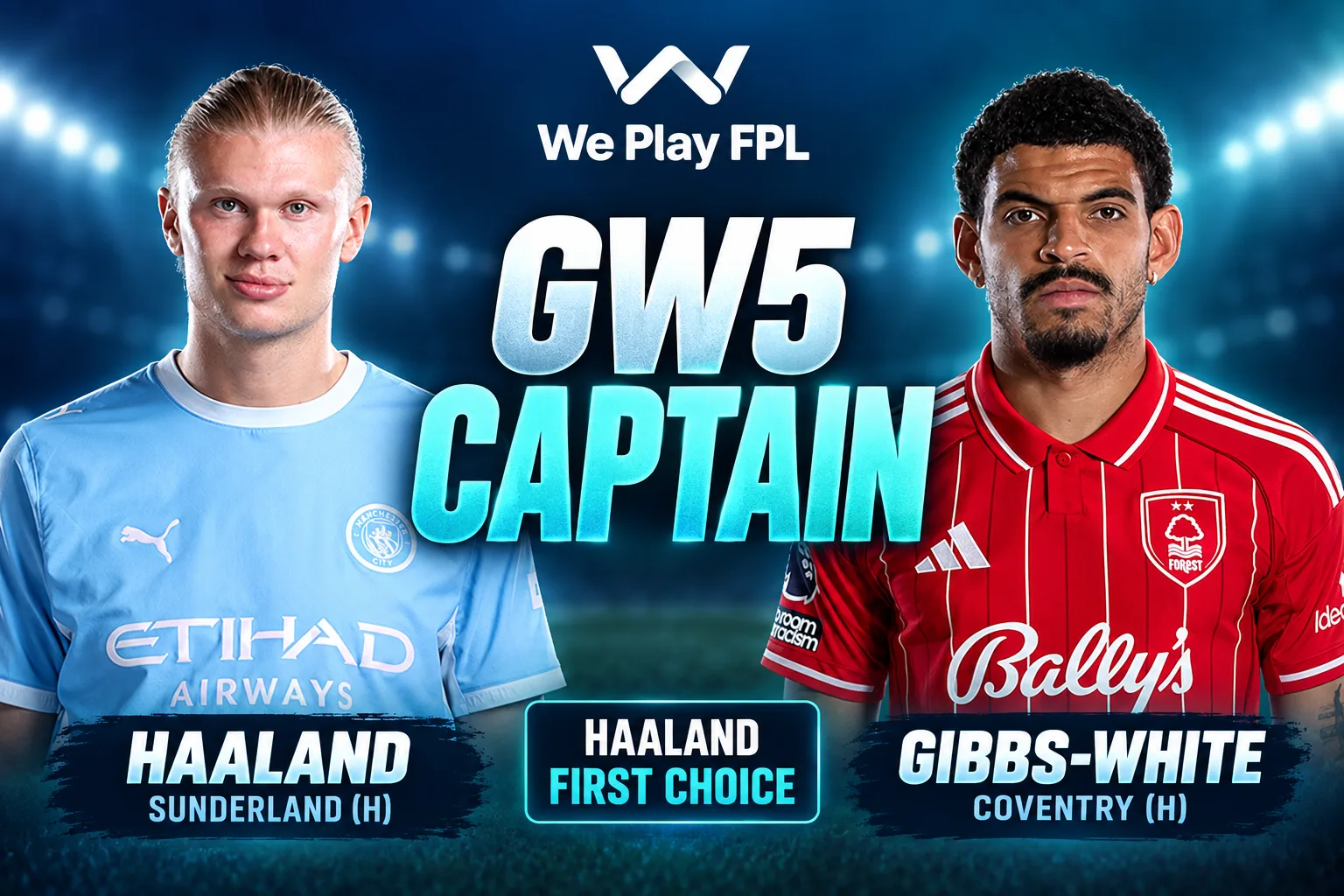
Captain Haaland in GW5 if you own him and he remains available. Manchester City host Sunderland, and his opening four matches give us the stronger attacking case. Gibbs-White offers a credible alternative at home to Coventry for managers without Haaland, but owners need a football reason to pass over the City forward.
Haaland has the stronger early attacking numbers
Haaland has played 360 minutes, producing 0.83 expected goals per 90 and 0.96 expected goal involvements per 90. Gibbs-White has also played 360 minutes, with 0.39 xG/90 and 0.65 xGI/90. Those equal samples make the comparison useful: Haaland has generated more shooting threat and more combined goal-and-assist involvement.
These are season-to-date performance rates through GW4. They do not forecast either player’s GW5 score. Four matches leave room for opponent strength, individual chances and match circumstances to influence the numbers. We prefer Haaland because his attacking record supports the home fixture, while accepting that Gibbs-White can outscore him in one match.
Gibbs-White gives non-owners a credible captain
Gibbs-White faces Coventry at home. At £8.0m, he occupies a different budget slot from the £15.5m Haaland, so a manager can own him in a squad that spends its money elsewhere.
His 0.65 xGI/90 supports considering him for the armband. His 0.39 xG/90 also shows why we would keep Haaland ahead in this comparison: Gibbs-White has produced less direct goal threat in the same minutes. Remember their different FPL positions when comparing them. Haaland is a Forward; Gibbs-White is a Midfielder. A chance-involvement rate alone cannot settle their eventual FPL points.
If you already own Gibbs-White without Haaland, you have a viable home-fixture captain to assess. This captaincy preference does not establish that you should restructure your squad to buy Haaland for one deadline. Buying a premium forward involves the players you sell, the transfers you spend and the team you can field afterwards.
Choose your captain within the squad you plan to keep
Compare the available captains before making a transfer to change the armband. You can test line-ups and assign future captains in We Play FPL, which helps you see whether a proposed purchase suits more than the next match.
For Haaland owners, our first choice is Haaland. For managers without him who own Gibbs-White, the Forest midfielder deserves consideration against Coventry. Choosing Gibbs-White over an available Haaland means accepting the weaker early attacking numbers in exchange for a different outcome; being different alone is not our reason to recommend it.
Check fitness and expected availability before the GW5 deadline at 17:30 UTC on Friday 18 September. Both players currently have available status and no injury note in the game. Revisit the choice if that changes, and select an available vice-captain alongside your final armband.