Chip Strategy
FPL GW2 Bench Decisions: Tzolis, Calvert-Lewin and the Extra Defender
Tzolis or Calvert-Lewin? Weigh their GW2 minutes and roles, account for Wirtz’s early substitution, and give your attacking defenders a fair chance of starting.

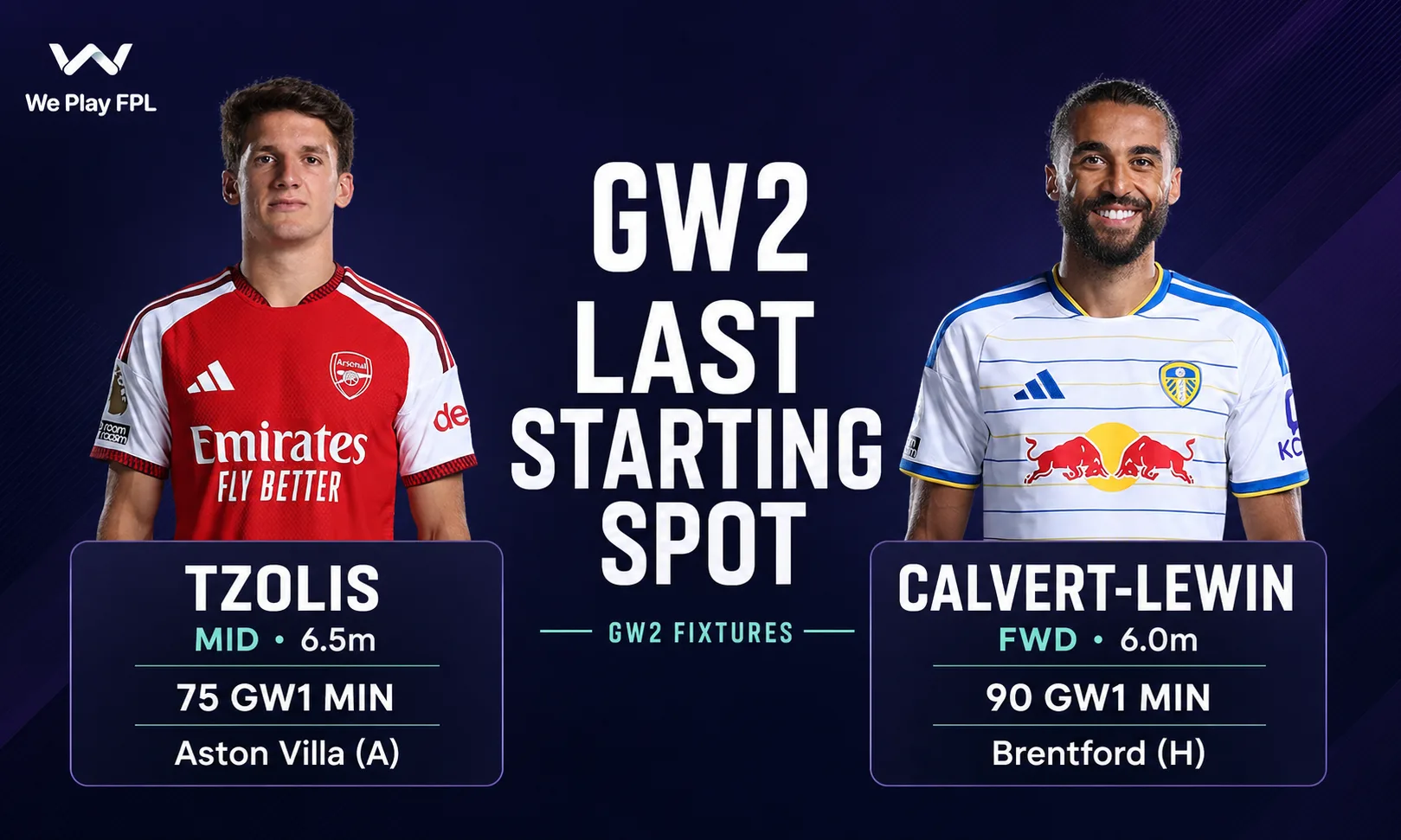
Choosing your last outfield starter for Gameweek 2 means weighing a close attacking pick against the defenders you could play instead. Christos Tzolis and Dominic Calvert-Lewin offer different reasons for selection. Florian Wirtz brings a minutes question, while Riccardo Calafiori and Nico O’Reilly deserve consideration beyond the standard three-defender formation.
For this decision, compare the players you own. Their prices explain how you built the squad, but the more expensive player has no automatic claim on a starting place.
Tzolis or Calvert-Lewin: decide how much you value the minutes
Tzolis costs 6.5m and occupies a midfielder slot. He played 75 minutes in Gameweek 1 and visits Aston Villa with Arsenal in GW2. You can make a case for starting him if you want exposure to Arsenal’s attack and accept the possibility of another substitution before full time.
Calvert-Lewin costs 6.0m, occupies a forward slot and faces Brentford at home with Leeds. He played 90 minutes in the opening match and holds first place in Leeds’ penalty order. Those are concrete reasons to consider him for your XI, even after his GW1 blank.
If you place greater weight on a full-match appearance and an established penalty position, Calvert-Lewin has the clearer case. A penalty remains a possibility, not an expected return, and one 90-minute appearance cannot guarantee the next. Tzolis remains a reasonable choice for managers who prefer his involvement in Arsenal’s attack.
Keep the margin between them small. We have one league appearance from each this season, which gives us too little evidence for a confident points ranking. A credible update on either player’s expected start or minutes should carry more weight than a narrow preference formed before the team news.
Wirtz: account for the 62 minutes
Florian Wirtz is a 7.5m midfielder with Nottingham Forest at home in GW2. He played 62 minutes in the opening match. You can like the fixture while allowing for another early substitution in your selection judgment.
Starting him means accepting that trade-off: involvement in Liverpool’s attack at home, with uncertainty over how long he plays. Bench him only if you can name a stronger case for the alternative in your squad. His price alone should neither protect his place nor encourage you to force him out after one match.
A longer appearance would strengthen the case for future starts in your XI. Until he supplies that evidence, avoid treating 80 or 90 minutes as the default expectation.
Give the fourth defender a fair comparison
Riccardo Calafiori costs 5.6m and visits Aston Villa with Arsenal. Nico O’Reilly costs 6.5m and visits Crystal Palace with Man City. Both occupy defender slots in FPL and offer attacking potential alongside their clean-sheet opportunity.
Calafiori played 80 minutes in GW1; O’Reilly played 62. Include that difference in your assessment, with the same caution about a one-match sample that applies to Wirtz. Attacking involvement does not remove a defender’s substitution risk.
If you expect one of these defenders to start and prefer his combination of attacking involvement and clean-sheet opportunity to your weakest attacking selection, use the extra defender. You do not need to preserve a 3-4-3 or 3-5-2 formation at the expense of the player you prefer.
Set the XI before the deadline
Compare the final outfield candidates on expected minutes and their routes to points. For Tzolis versus Calvert-Lewin, choose between Arsenal attacking exposure and the Leeds forward’s opening-match minutes and penalty position. For Wirtz or an extra defender, account for substitution risk on both sides of the comparison.
Recheck the expected starters before the GW2 deadline on Friday 28 August at 17:30 UTC, 20:30 in Cairo. After the matches, use the new minutes evidence to reassess the close calls for GW3.






Chip Strategy
GW8 defender rotation: Muharemović now or Van Hecke later?
Muharemović offers a GW8 entry point, Van Hecke has later home fixtures and Silva provides another route from GW9. Match the purchase to your planned starts.

Tarik Muharemović is our preference among these budget defenders if you need a GW8 starter. Jan Paul van Hecke makes more sense if you can cover this week and want a defender for the home games in GW9 and GW11. Before spending around £5.0m, mark the weeks in which your new signing must play.
That distinction matters on a Wildcard, too. You can afford a tougher opening fixture for a fourth defender if your other three have suitable matches. A defender who has to start this weekend needs a different assessment.
Muharemović for the immediate vacancy
Muharemović costs £5.0m and faces Sunderland away in GW8. We prefer that entry fixture to Van Hecke’s trip to Chelsea or Silva’s visit to Manchester United. The case depends on needing him this week: Leeds then visit Bournemouth, host Spurs and travel to Chelsea.
He has averaged 90.0 min/match. His defensive contributions offer another scoring route alongside a possible clean sheet, with a season-to-date DefCon/90 of 10.43. Treat that as a rate across matches, not a promise that he will reach the scoring threshold in the next one.
His expected goals conceded rate is 1.39 xGC/90, while his attacking involvement stands at 0.11 xGI/90. Those figures support a measured purchase for a specific starting gap. They give little reason to expect regular attacking returns or to buy him without checking the rest of the Leeds run.
Van Hecke for GW9 and GW11 cover
Van Hecke costs £4.9m. Spurs face Chelsea away in GW8, Crystal Palace at home in GW9, Leeds away in GW10 and Ipswich Town at home in GW11.
The two home fixtures make him worth considering if your defence needs help in those weeks. Buy him before GW8 only if you can accept the Chelsea fixture or leave him on the bench without weakening your starting defence. You can wait until GW9 if you have no need to make the move before then.
He has averaged 90.0 min/match, with 1.34 xGC/90 and 0.17 xGI/90. His DefCon/90 is 9.29, below Muharemović’s 10.43. The small gap between their expected goals conceded rates does not establish a clear winner for the next match; their opponents and your planned starts deserve more weight in this choice.
Silva offers a different route from GW9
Silva costs £5.0m and starts with Manchester United away. Bournemouth then host Leeds, visit Ipswich Town and host Nottingham Forest in GW9–11. Consider him if you want a defender you can use across that stretch, rather than someone you need for GW8 alone.
He has averaged 90.0 min/match. His rates are 1.16 xGC/90, 0.24 xGI/90 and 10.43 DefCon/90. He has the lowest expected goals conceded rate and the highest attacking involvement rate of this trio, but those season-to-date measures do not forecast his next three scores. Check the fixtures against your other defenders before paying the extra £0.1m over Van Hecke.
Map the starts before buying
Write down your three intended starting defenders for GW8 through GW11, then identify the vacant slots. You can map future lineups and compare rotation options in We Play FPL before committing the transfer. The planner supports future squad drafts and lineups, while the rotation scout helps assess player combinations across upcoming fixtures.
For a GW8 vacancy, we lean towards Muharemović. For gaps in GW9 and GW11, Van Hecke’s home fixtures warrant a closer look. Silva suits a manager who can cover GW8 and wants another option for the following run.
Keep the cost of the whole defence in view. Spending around £5.0m on a fourth defender needs a purpose if the extra money could improve a regular starter elsewhere. Check availability and the expected starting lineups before the GW8 deadline on 23 October at 17:30 UTC, then choose the player for the weeks you intend to use him.
Chip Strategy
GW7 defence: start Muharemović or Hall?
We lean towards Muharemović for GW7 when you own both defenders. Compare his defensive contribution rate with Hall’s greater attacking involvement before setting your XI.

Start Tarik Muharemović ahead of Lewis Hall if you own both and have one place available in your GW7 defence. We lean towards Muharemović for his defensive contributions and his lower rate of expected goals conceded. Hall offers more attacking involvement, so treat this as a close call.
Both play at home: Leeds face Manchester United and Newcastle face Aston Villa. You can make this choice through your starting lineup without spending a transfer.
Muharemović has the stronger defensive contribution rate
Muharemović averages 11.33 defensive contributions per 90, compared with Hall’s 8.68. At an average of 90.0 minutes per match, he has also given owners a dependable playing-time record. Hall averages 89.8 minutes per match, so neither player has a meaningful advantage in historical playing time.
We prefer Muharemović because he has done more defensive work across that similar match opportunity. A season average cannot guarantee a defensive contribution return against Manchester United, but it gives us a reason to favour him when deciding between two available defenders.
He also has the lower xGC/90: 1.46 against Hall’s 1.77. That measure describes the quality of chances conceded while each player was on the pitch. It does not provide a clean-sheet probability for this weekend. You still need to account for the opponent, and we would avoid presenting either home fixture as a comfortable clean sheet.
Hall offers more attacking involvement
Hall has recorded 0.19 expected goal involvements per 90, compared with Muharemović’s 0.09. His greater attacking involvement gives you a sound reason to start him if you prefer that route to points.
Those attacking rates remain modest. You would need more than this gap to treat a Hall return as likely or to dismiss Muharemović’s defensive contribution advantage. We favour the latter for GW7 while recognising that Hall can reward owners who make the other choice.
For a side-by-side check of performance data and upcoming fixtures, you can compare both defenders in We Play FPL before setting your lineup. Keep any predicted points separate from the historical rates used here; predictions do not guarantee a result.
Make the lineup decision for the players you own
At £5.0m for Muharemović and £5.3m for Hall, the price difference has no effect on this week’s starting choice for managers who own both. Keep the transfer decision separate: a marginal preference for one fixture provides little reason to sell Hall.
Check final fitness and expected starts before the GW7 deadline on 17 October at 10:00 UTC. Both have clear availability flags at the time of writing. If that changes, reassess the choice. With both available and one starting slot to fill, our pick is Muharemović.
Chip Strategy
GW7 Wildcard: budget for Palmer, Rogers and João Pedro
Chelsea’s attacking triple costs £25.4m. Compare it with a two-player draft across GW7–13, using attacking rates, average minutes and the bench you can afford.

Palmer, Rogers and João Pedro cost £25.4m between them. A GW7 Wildcard can accommodate all three Chelsea attackers, but you need enough money left for the rest of your starting XI and a bench you can use.
Our preference is to build the squad across Chelsea’s GW7–13 fixtures, then decide whether the third attacker earns his place. Pick two if buying all three forces you to accept weak cover or a starter you would otherwise replace.
Give the Chelsea picks seven fixtures
Chelsea visit Everton in GW7, then host Spurs and Manchester United. They follow that with Sunderland away, Leeds at home, Nottingham Forest away and Crystal Palace at home.
That gives you four home matches across seven Gameweeks. You can hold the attackers through several fixtures instead of expecting the Everton match to justify the whole investment. You still need to accept the away games and check each player’s fitness and starting outlook before the deadline.
Plan a review around GW14, when Chelsea host Liverpool, followed by Manchester City away in GW15. Those matches give you a reason to reassess the triple rather than commit three club slots without a later checkpoint.
Compare the price with the attacking evidence
Palmer and Rogers are FPL midfielders; João Pedro is a forward. Buying all three uses two midfield places, one forward place and your three Chelsea slots.
- Palmer: £9.7m. He averages 88.2 min/match, with 0.37 xGI/90.
- Rogers: £7.9m. He averages 86.7 min/match, with 0.55 xGI/90.
- João Pedro: £7.8m. He averages 86.2 min/match, with 0.64 xGI/90.
Here, xGI/90 means expected goal involvements per 90 minutes. These are season-to-date performance rates, not predictions for the next fixture. Read them alongside average minutes per match; a player still needs time on the pitch to turn his attacking involvement into FPL returns.
Palmer costs £1.8m more than Rogers despite the lower attacking rate so far. That gap deserves scrutiny when you build the Wildcard. You can prefer Palmer, but paying the extra needs to fit the squad you want rather than follow his price tag.
Rogers and João Pedro offer the cheaper route into two Chelsea attacking slots. Their playing-time records support consideration, although past appearances cannot guarantee the next start. Check current team news before locking either into your XI.
Put two-player drafts beside the triple
Rogers and João Pedro cost £15.7m together. Palmer and João Pedro cost £17.5m, while Palmer and Rogers cost £17.6m.
Build the £25.4m triple beside the pair you would otherwise choose. Then inspect the players you can afford in the remaining positions. If the triple forces an avoidable weakness in defence or leaves you without a usable substitute, keep the pair and spend elsewhere.
You can test future squad drafts in We Play FPL to map transfers and line-ups across the Chelsea holding period. Put your preferred pair and the triple into separate drafts, then check who starts when you need cover. A bench player has more value when you can identify the Gameweeks in which you will use him.
Three Chelsea attackers also leave you no Chelsea slot for a goalkeeper or defender. Include that restriction in the comparison if you had planned to use a defensive pick from the same club.
Buy the third attacker when the squad can support him
Choose the triple if you want to hold all three through GW7–13 and can retain a starting XI and bench you trust. Choose two when the third player takes money from a more useful squad improvement.
Before the GW7 deadline on 17 October at 10:00 UTC, check availability and expected starts, then review the whole draft. The Chelsea fixture run gives you a reason to invest; your budget decides how many attackers to buy.