Chip Strategy
FPL GW3 Transfers: Buy Wissa for Four Fixtures, De Cuyper for Two
Wissa offers a four-match forward run; De Cuyper needs a two-Gameweek plan before Brighton host Arsenal. Use holding period and squad need to decide.

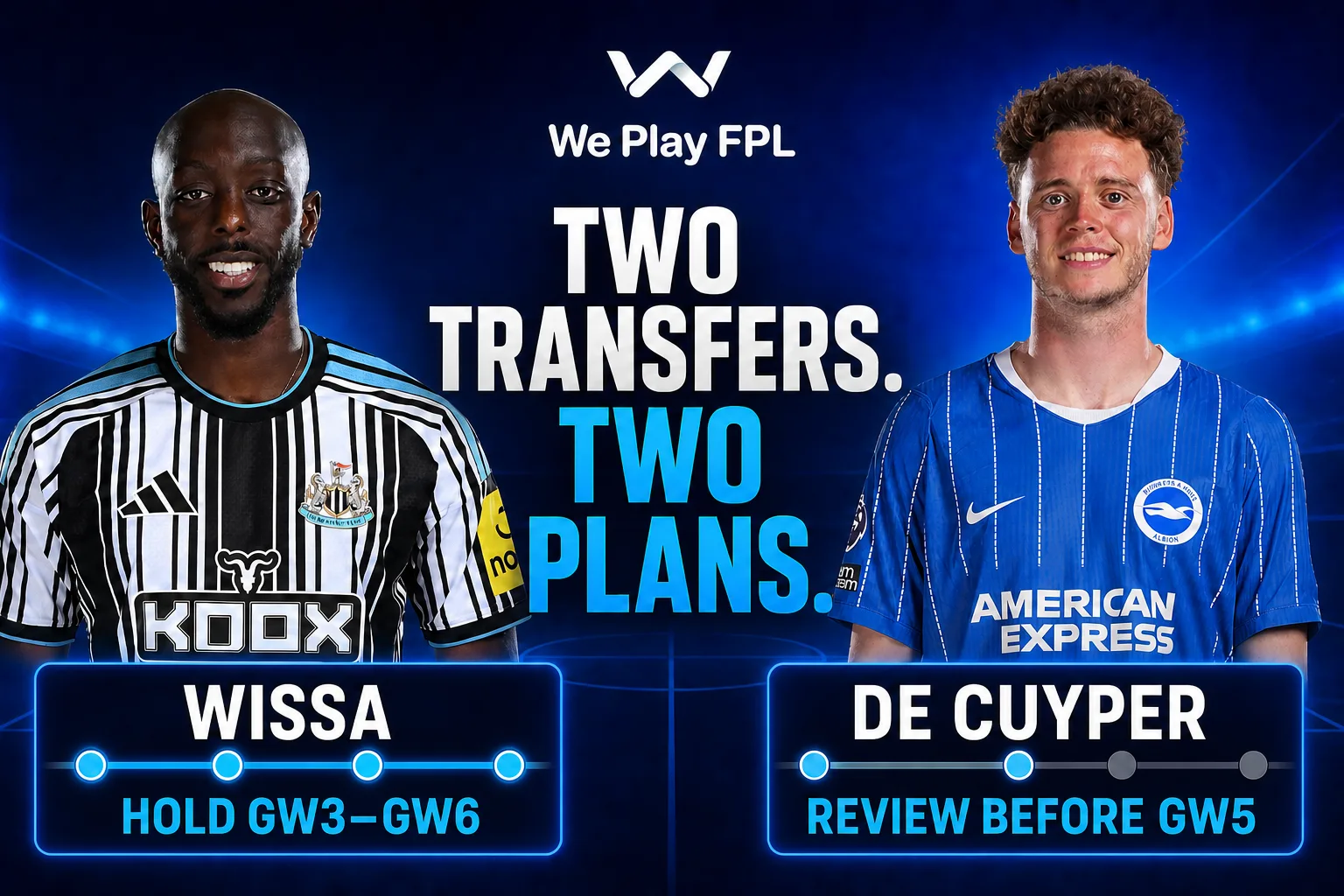
Yoane Wissa and Maxim De Cuyper enter Gameweek 3 with returns on the board and useful prices. Each move needs a different holding period. Wissa offers a four-match forward run at 6.1m. De Cuyper offers two inviting fixtures at 4.7m before Brighton host Arsenal.
Wissa has started both Newcastle matches, played 171 minutes and scored 12 points through one goal and one assist. De Cuyper has 17 points from two starts and 167 minutes, but every return came in his 17-point Gameweek 1 haul. His zero against Chelsea in GW2 showed the week-to-week swing that comes with an attacking defender.
Your squad should decide which transfer fits. A weak forward slot can justify Wissa through GW6. A defender problem can justify De Cuyper for GW3 and GW4 when you already have cover for the Arsenal fixture.
Give Wissa the full GW3 to GW6 run
Newcastle host Bournemouth in GW3, visit Leeds in GW4, host Hull City in GW5 and travel to Coventry City in GW6. That sequence gives Wissa buyers four matches before they need another decision.
His opening minutes support the plan. Wissa has started twice, played 171 of 180 available minutes and remains available. One goal and one assist have produced 12 points. At 9.1% ownership, he offers a route away from more crowded forward picks without asking you to accept an unproven starting role.
Buy Wissa when the move removes a weak starter, replaces an unavailable forward or improves the use of money elsewhere. Keep the transfer when it forces a sale from a forward who already has secure minutes and a comparable fixture run. The 6.1m price helps when the full squad benefits from the saving.
Managers who buy should plan to hold through GW6 while Wissa starts and stays available. One blank against Bournemouth or Leeds should not trigger another transfer. A benching, reduced minutes or a fitness flag would give you a reason to review sooner.
Treat De Cuyper as a two-match defender move
Brighton host Leeds in GW3 and visit Coventry City in GW4. Arsenal then visit Brighton in GW5, which changes the short-term appeal. Sunderland away follows in GW6.
De Cuyper costs 4.7m, has started both matches and sits in 13.3% of teams. His one goal, one assist and clean sheet all came in GW1. Brighton conceded four goals in GW2 and De Cuyper returned zero points, so buyers should separate his attacking upside from the clean-sheet part of the pick.
The move works when you need a starting defender for the next two deadlines and can bench him against Arsenal. It also works when the 4.7m slot releases money for a stronger upgrade elsewhere. The plan becomes weaker if your bench cannot cover GW5 or if buying him would force another defender transfer after two matches.
De Cuyper can still earn a place beyond GW4, but buyers should set the review date now. Check Brighton’s defensive form, his starts and your GW5 bench before deciding whether to keep him through Sunderland away.
Match the transfer to the squad problem
Wissa and De Cuyper solve different problems. Wissa fills a forward slot for a four-match run. De Cuyper fills a defender slot for two fixtures with a planned review before Arsenal.
Start with your weakest starter. Compare the replacement’s minutes, fixtures and price with the player leaving. Then check the second effect of the move: the money released, the bench cover created or the next transfer it might require.
A points total from two Gameweeks should not settle the call. Wissa has spread his returns across both matches. De Cuyper collected his returns in one match. Their upcoming fixtures and your intended holding period provide a stronger transfer test.
Set the review date before the GW3 deadline
Wissa buyers can target GW6 as the first planned review while he keeps his place. De Cuyper buyers should review before GW5 and make sure another defender can cover Arsenal at home.
Check Newcastle and Brighton team news before the deadline. If both remain available and start, choose the player who fixes the more urgent slot and commit to the planned run.






Chip Strategy
GW10 captaincy: Haaland or Gabriel for the armband?
Haaland leads our GW10 captaincy picks, with Gabriel at home to Hull the alternative. Compare their scoring routes and check Calafiori’s workload.

Haaland gets our GW10 captaincy vote away to Forest. Gabriel is a credible alternative at home to Hull for managers willing to back Arsenal’s clean-sheet prospects and his attacking threat. Choose between those routes after checking selection news, with Haaland our first choice if you own both.
Gabriel’s home fixture deserves consideration. His season-long playing time and several ways to score make him more than a punt on a header. The trade-off is the weight you place on a defender’s clean sheet against Haaland’s stronger attacking involvement.
Haaland offers the stronger attacking case
Haaland averages 88.8 min/match and records 0.74 xG/90, with 0.84 xGI/90 once expected assists are included. At £15.8m, he takes a large share of the squad budget, but owners can captain him without spending a transfer or changing their team structure.
Manchester City visit Forest in GW10. The away venue gives Gabriel’s home match some appeal, though choosing Haaland still means backing the player with the more substantial attacking record in this comparison. His goal threat is the main reason for our preference.
These rates describe season-to-date performances. A 0.84 xGI/90 figure is neither a GW10 points prediction nor a promise of a goal involvement. Use it to judge the attacking case, then check whether new fitness or selection information changes your confidence before the deadline.
Gabriel gives you a different route to returns
Gabriel costs £8.0m and averages 90.0 min/match. He has 0.80 xGC/90 and 0.19 xGI/90, including 0.16 xG/90. Against Hull at home, managers can back the combination of defensive returns and his threat from set pieces.
His 9.00 DefCon/90 adds context to the defensive case. It measures defensive contributions per 90 minutes; it does not guarantee contribution points in this match. The same caution applies to clean sheets: xGC/90 measures expected goals conceded while he is on the pitch, rather than the chance of shutting out Hull.
Gabriel’s attacking rate sits below Haaland’s. That does not settle the captaincy by itself because defenders have other scoring routes, but it explains what you accept by choosing him. You put more weight on Arsenal keeping a clean sheet and on Gabriel adding another return.
For a manager who owns Gabriel without Haaland, he is a defensible captaincy option. For an owner of both, we lean Haaland unless fresh team news changes the assessment. Keep a purchase decision separate from the armband: Gabriel’s captaincy appeal this week alone does not justify spending a transfer and £8.0m.
Check Calafiori’s workload before choosing another Arsenal captain
Calafiori shares the Hull home fixture and costs £5.9m. He records a higher attacking-involvement rate than Gabriel at 0.29 xGI/90, alongside 0.85 xGC/90 and 4.64 DefCon/90. His average playing time is lower at 77.7 min/match.
That combination makes a selection check important. Reassess his workload after the midweek match and the available information about his next start. A good fixture gives little protection from reduced playing time, and a short appearance can leave you relying on the captain you chose rather than your vice-captain.
We prefer Gabriel within this Arsenal captaincy comparison unless team news gives a reason to change. Calafiori’s stronger xGI/90 alone is insufficient to move him ahead when Gabriel has the longer played average and stronger defensive-contribution rate. Neither historical average guarantees a start this weekend.
Make the call with the players you own
You can test captains and future line-ups in the We Play FPL planner before changing your live squad. Compare the armband choices within your current team, then consider transfers as a separate decision. A captaincy change costs no transfer; buying a player for one attractive fixture can affect several later weeks.
Our order is Haaland first, Gabriel the alternative, with Calafiori requiring a closer workload and selection check. Recheck availability before the GW10 deadline on 6 November at 18:30 UTC and choose a vice-captain you expect to play.
Chip Strategy
GW10 defenders: Silva or Vušković for a deeper squad?
Silva edges Vušković for a new defender purchase. Compare their rates and planned starts, then build defensive depth without forcing five at the back.

Silva gets our vote over Vušković for a new defender around £5m in GW10. At £5.1m, he costs £0.1m less and combines a lower xGC/90 with stronger attacking involvement and defensive contribution rates. The gap is small enough that your intended starts should decide a close call.
First, check whether you need another defender. You can build a squad with five usable options and choose four or five at the back when their fixtures justify it. You can also leave two on the bench when your attackers offer more. Spend a transfer on a defender you expect to start in a specific week, rather than buying one to complete a preferred formation.
Silva has the stronger balance of rates
Silva averages 90.0 min/match for Bournemouth. His 1.11 xGC/90 sits below Vušković’s 1.44, while his 0.18 xGI/90 edges the Brighton defender’s 0.16. He also leads on DefCon/90, 10.33 to 9.60.
Those differences support the buying preference, but none promises a return. xGC/90 describes expected goals conceded during the player’s time on the pitch; it does not rank an entire defence or predict the next clean sheet. xGI/90 describes expected goal involvement to date. DefCon/90 measures defensive contributions per 90 minutes, so a higher rate does not guarantee contribution points in a particular match.
Vušković costs £5.2m and averages 88.6 min/match. Both offer substantial playing time on their season averages, though managers still need to check selection news before the deadline. Silva has three yellow cards to monitor; Vušković has none.
For a fresh purchase with no fixture-specific reason to choose otherwise, we lean Silva. For an existing Vušković owner, the small rate differences give little reason to spend a transfer switching between the two.
Choose the weeks you need the extra starter
Bournemouth visit Ipswich in GW10, host Forest in GW11 and travel to Fulham in GW12. Brighton host Brentford, visit Hull and host Newcastle across the same three Gameweeks.
A manager who needs a home starter this week may prefer Vušković. A manager buying across the whole period may accept Silva’s opening away match for his combination of price and performance rates. Neither choice requires starting the new defender in all three fixtures.
Write down your likely XI for each week before buying. If both players would spend most of that period on your bench, keep the transfer for a clearer improvement. If one fills a specific gap, judge him against the player who would otherwise start in your team.
You can test future line-ups in the We Play FPL planner to compare those starts before changing your live squad. Use that plan to check whether a fourth defender improves your XI and whether the fifth offers cover you will use.
Build the bench through available transfers
Five playable defenders give you more choices after an injury or a difficult fixture. You still need enough money in attack. Avoid a hit whose only purpose is to impose four or five at the back, and keep a healthy starter if the replacement would spend the next week on the bench.
Defensive contributions add another scoring route, but managers should assess them alongside clean-sheet potential and attacking involvement. Buying the highest DefCon/90 alone can leave you paying for a player whose fixtures or playing time do not fit your squad.
Use the next free transfer to fix the weakest planned start. Silva is our first look if that means buying a defender around £5m; Vušković remains a close alternative when Brighton’s fixtures better match your needs. Recheck availability before the GW10 deadline on 6 November at 18:30 UTC, then choose the XI from the players you own.
Chip Strategy
GW9 Liverpool defence: Jacquet, Araujo or Van Dijk?
Jacquet offers Liverpool defensive value at £5.1m; Van Dijk has the stronger playing-time record. Compare the price tiers and plan your starts from GW10.

Jeremy Jacquet is our first Liverpool defender to consider if you want to keep the cost down. At £5.1m, he costs £0.3m less than Ronald Araujo and £1.3m less than Virgil van Dijk. His playing-time record and defensive contribution rate make that saving worth taking seriously.
For a new purchase, we would reassess after Arsenal at home in GW9. You can then decide whether Liverpool’s GW10–14 fixtures suit the weeks you need a defender. Van Dijk offers the stronger playing-time record if you have room for £6.4m; Araujo needs a clearer reason for the extra spend over Jacquet.
Jacquet offers the cheaper route
Jacquet has averaged 85.3 minutes per match, with 9.37 defensive contributions per 90. Araujo has averaged 61.6 minutes per match and 7.85 defensive contributions per 90. Neither average promises a future start, but Jacquet has given owners more playing time so far.
The attacking numbers offer little reason to pay up for Araujo. Jacquet has 0.07 expected goal involvements per 90 (xGI/90), compared with Araujo’s 0.02. Both rates are low, so we would buy either for the defensive role and budget fit rather than an expectation of regular attacking returns.
Araujo has the lower expected goals conceded rate: 0.97 xGC/90 against Jacquet’s 1.16. That deserves a place in the comparison, but the players have spent different amounts of time on the pitch. We would not treat it as proof that choosing Araujo gives you a better chance of a clean sheet in the next match.
Our lean is Jacquet when choosing between the two at current prices. Fresh selection news could change that call. Paying another £0.3m makes more sense if you can identify a role or playing-time advantage that the current record does not show.
Van Dijk costs £1.3m more for a stronger minutes record
Van Dijk has averaged 90.0 minutes per match. That is the strongest record of the three, alongside 9.75 defensive contributions per 90. His 1.20 xGC/90 and 0.05 xGI/90 do not establish a large expected-performance advantage over Jacquet.
At £6.4m, we would choose Van Dijk when you can afford the premium and place a high value on his playing-time record. You still need to check availability and selection news; a historical average cannot guarantee his next start.
For a tighter budget, Jacquet leaves £1.3m available elsewhere. Compare what you gain from that saving with the extra playing-time confidence you want from Van Dijk before committing to either player.
Plan the starts from GW10
Liverpool’s schedule after Arsenal includes three away matches in five:
- GW10: Crystal Palace away.
- GW11: Man Utd at home.
- GW12: Everton away.
- GW13: Sunderland at home.
- GW14: Chelsea away.
You need a plan for that whole stretch. A lower price helps, but you may still want another defender available for selected away fixtures. You can compare Liverpool’s defensive options in We Play FPL using player statistics and upcoming fixtures, then map out the starts in the planner.
We would shortlist Jacquet for value and Van Dijk for the stronger playing-time record, then revisit the choice after GW9 with fresh team news. Araujo’s lower xGC/90 merits attention, but his shorter average appearances and higher price leave us preferring Jacquet for the cheaper slot. These season-to-date rates describe past performance; they do not predict clean sheets or attacking returns.