Fixtures
GW8 Brighton defence: hold De Cuyper or switch to Vušković?
Keep De Cuyper unless a sale solves a wider squad problem. Compare his attacking rate with Vušković’s defensive contributions, and reassess new Brighton purchases near GW10.

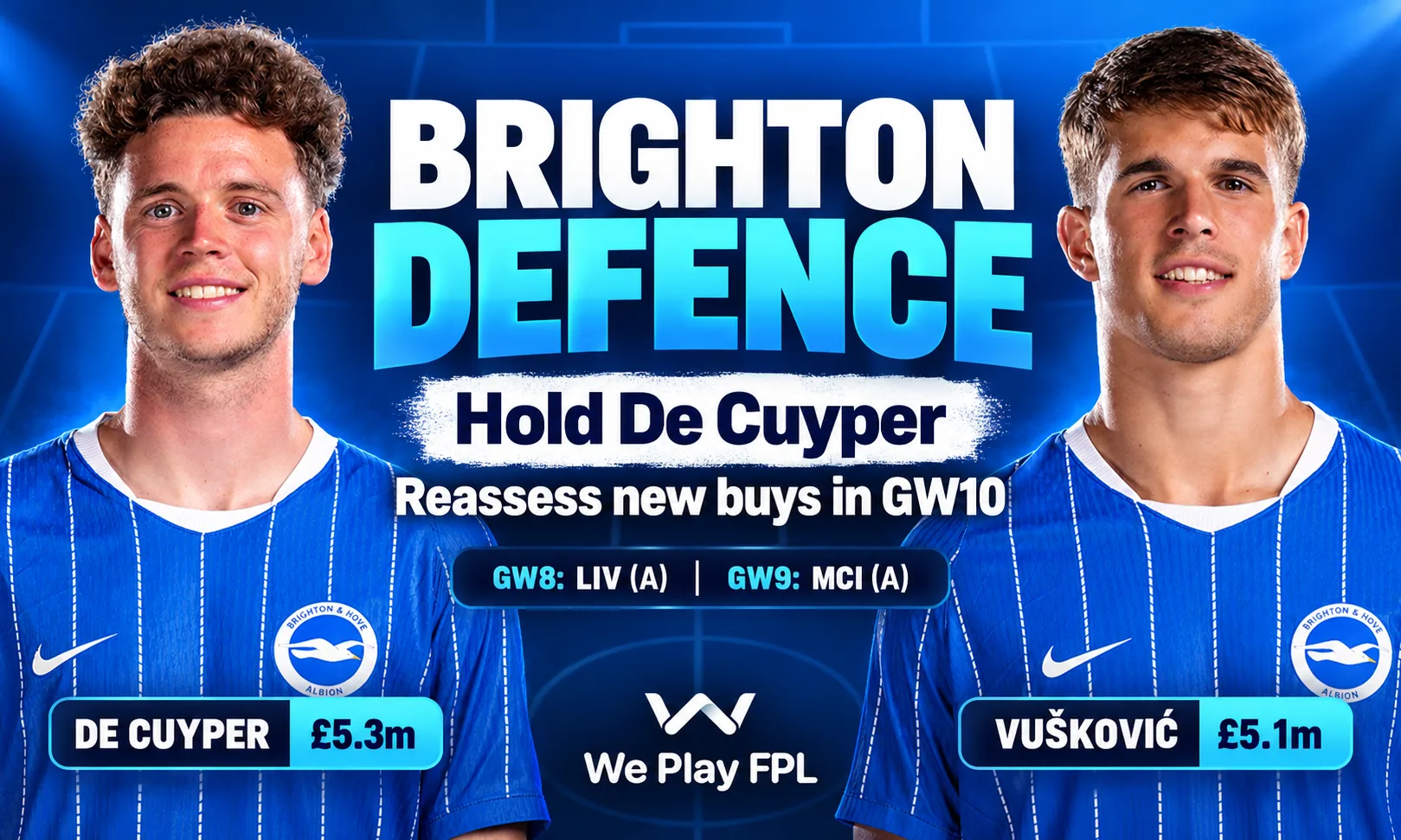
Keep De Cuyper for GW8 unless selling him solves a wider problem in your squad. Liverpool away and Manchester City away make Brighton defenders awkward starters over the next two Gameweeks, but switching from De Cuyper to Vušković would leave you facing the same opponents.
For managers buying a defender, we would wait until nearer GW10 to reassess Brighton. Existing owners have a different decision: use a stronger bench option where you have one, preserve the transfer and judge the fixture run beyond those two away matches.
Two difficult trips before the fixtures improve
Brighton visit Liverpool in GW8 and Manchester City in GW9. They then host Brentford in GW10 and visit Hull City in GW11. Both defenders could offer more appeal once that later window arrives, although favourable fixtures cannot guarantee clean sheets.
Selling now and buying back for GW10 uses two transfers. That can make sense if the replacement improves your starting XI across several weeks, but it is an expensive way to avoid two fixtures when your bench can cover them.
Before making the move, sketch your GW8 and GW9 lineups and the defender you would want in GW10. You can plan those future lineups in We Play FPL, including the transfers you would need to get there. Judge the move by the starting XI it improves and the transfers it consumes.
De Cuyper gives you the stronger attacking rate
At £5.3m, De Cuyper has produced 0.40 expected goal involvements per 90 minutes, compared with Vušković’s 0.18. That makes De Cuyper the more appealing of the two if you want attacking involvement from your defender.
He has averaged 82.9 minutes per match, with 1.54 expected goals conceded per 90 and 3.57 defensive contributions per 90. His attacking rate gives him a route to points when Brighton concede, but you still need to accept the defensive risk against Liverpool and City.
We would hold him if the proposed sale is a straight swap to Vušković. If you must start De Cuyper this week, his attacking involvement gives you a reason to play him; it does not make him a clean-sheet favourite.
Vušković offers a different scoring route
Vušković costs £5.1m and has averaged 88.1 minutes per match. His 10.21 defensive contributions per 90 stand well above De Cuyper’s 3.57, giving managers a stronger defensive-contribution case to consider alongside the £0.2m saving.
His other rates are 0.18 expected goal involvements per 90 and 1.45 expected goals conceded per 90. The lower attacking figure matters if you are chasing a goal or assist. The defensive-contribution rate matters if you prefer that scoring route, but it is an average rather than a promise of points in any individual match.
All these rates describe season-to-date performance, not projected returns. Both players are FPL defenders, and neither can escape Brighton’s immediate fixture risk.
For a new purchase around GW10, Vušković deserves consideration if the saving helps elsewhere and you value his defensive contributions. De Cuyper remains the attacking choice. Check their availability and recent selections again before buying.
Make the transfer earn its place
Our GW8 call is to retain De Cuyper and avoid a sideways Brighton switch. Bench him if your alternative has a stronger fixture and a credible starting role. If your squad cannot field a defence you are comfortable with, assess a replacement from another club over the full period you intend to own him.
Managers without a Brighton defender can wait through Liverpool and City, then compare De Cuyper’s attacking involvement with Vušković’s price and defensive contributions before GW10. You gain little by paying for the later fixture window before you need to.



Fixtures
GW8 budget midfield: Schade, Tavernier or Manzambi?
Tavernier gets our longer-term lean, Schade offers the immediate GW8 fixture, and Manzambi needs fitness news. Choose your budget midfielder by the weeks you need him.

Marcus Tavernier is our preference if you want a budget midfielder to keep beyond GW8. Kevin Schade has the more appealing immediate fixture. Johan Manzambi can wait until his fitness and starting place become clearer.
That distinction matters if you need to replace Dominik Szoboszlai or Sávio. Both carry injury flags, so check your bench before deciding how long you can wait. A replacement who suits the next deadline may need another transfer before your longer-term plan reaches its target.
Schade and Tavernier cost £6.2m; Manzambi costs £6.0m. All three are midfielders. Choose between them by the weeks you expect to start them and the cover you can use when the fixtures become harder.
Schade for an immediate GW8 start
Schade visits Hull City in GW8, then faces Nottingham Forest at home, Brighton away and Everton at home. If you need a player for your XI this week, he gets our fixture-based lean over Tavernier and Manzambi.
His attacking numbers give less reason to treat him as the automatic long-term choice. Schade has 0.38 expected goal involvements per 90 minutes, or xGI/90, with an average of 77.6 minutes per match. Tavernier and Manzambi have higher attacking expected rates so far. The immediate fixture is the main reason to favour Schade.
Plan an exit or bench cover before buying. Brentford face Manchester United away in GW12, Arsenal at home in GW13 and Manchester City at home in GW14. You can target the four matches before that run, but a squad with several other problems may struggle to spare the next transfer.
Tavernier for a longer hold
Tavernier starts with Manchester United away in GW8. Managers who buy him should accept that opening fixture because they want the matches that follow: Leeds at home, Ipswich Town away and Nottingham Forest at home in GW9–11.
He has 0.63 xGI/90 and an average of 82.0 minutes per match. His seven starts give us a more established starting sample than Manzambi’s three. Those figures support the preference for Tavernier when you want a replacement you can leave in the side; they do not guarantee his next start or return.
The run also leaves you options beyond GW11. Bournemouth visit Fulham in GW12, then host Brighton and Hull City. If you have limited free transfers and want to avoid booking another midfield move, Tavernier fits that plan better than a short Schade purchase.
Map the next few starting XIs before committing. You can plan future line-ups and transfers with We Play FPL to check whether you can cover Tavernier’s opening fixture or Schade’s later run without weakening another position.
Manzambi needs a fitness update
Manzambi has the highest attacking rate of the three at 0.71 xGI/90, alongside an average of 63.5 minutes per match. His smaller starting sample makes that rate a less secure basis for a transfer than the headline suggests.
He also carries a calf-injury flag with a 75% chance of playing. That percentage leaves uncertainty over his availability, and availability alone would not confirm a start. Buying him to solve an injury problem would add another fitness decision to your squad.
Aston Villa host Manchester City in GW8 and Fulham in GW9. Wait for fitness and selection news, then reassess the Fulham fixture as an entry point. His £6.0m price saves £0.2m against Schade or Tavernier, but that saving matters only if you can field a player you trust to start.
Make the transfer for your squad
If your bench cannot cover an injured midfielder in GW8, Schade offers the immediate fixture we prefer. Choose Tavernier when you can tolerate Manchester United away and want the longer hold. Keep Manzambi on the watchlist until the calf issue and starting outlook become clearer.
For Szoboszlai, the current hamstring flag gives no return date. Sávio’s muscular-injury flag lists an expected return on 7 November. Recheck both before selling, and weigh that news against the actual players available on your bench.
The xGI/90 figures describe expected attacking performance so far, rather than future points. Minutes above are averages per played match. Recheck fitness and prices before the GW8 deadline on 23 October at 17:30 UTC, then choose the move that leaves your next few teams strongest.
Chip Strategy
GW7 defence: start Muharemović or Hall?
We lean towards Muharemović for GW7 when you own both defenders. Compare his defensive contribution rate with Hall’s greater attacking involvement before setting your XI.

Start Tarik Muharemović ahead of Lewis Hall if you own both and have one place available in your GW7 defence. We lean towards Muharemović for his defensive contributions and his lower rate of expected goals conceded. Hall offers more attacking involvement, so treat this as a close call.
Both play at home: Leeds face Manchester United and Newcastle face Aston Villa. You can make this choice through your starting lineup without spending a transfer.
Muharemović has the stronger defensive contribution rate
Muharemović averages 11.33 defensive contributions per 90, compared with Hall’s 8.68. At an average of 90.0 minutes per match, he has also given owners a dependable playing-time record. Hall averages 89.8 minutes per match, so neither player has a meaningful advantage in historical playing time.
We prefer Muharemović because he has done more defensive work across that similar match opportunity. A season average cannot guarantee a defensive contribution return against Manchester United, but it gives us a reason to favour him when deciding between two available defenders.
He also has the lower xGC/90: 1.46 against Hall’s 1.77. That measure describes the quality of chances conceded while each player was on the pitch. It does not provide a clean-sheet probability for this weekend. You still need to account for the opponent, and we would avoid presenting either home fixture as a comfortable clean sheet.
Hall offers more attacking involvement
Hall has recorded 0.19 expected goal involvements per 90, compared with Muharemović’s 0.09. His greater attacking involvement gives you a sound reason to start him if you prefer that route to points.
Those attacking rates remain modest. You would need more than this gap to treat a Hall return as likely or to dismiss Muharemović’s defensive contribution advantage. We favour the latter for GW7 while recognising that Hall can reward owners who make the other choice.
For a side-by-side check of performance data and upcoming fixtures, you can compare both defenders in We Play FPL before setting your lineup. Keep any predicted points separate from the historical rates used here; predictions do not guarantee a result.
Make the lineup decision for the players you own
At £5.0m for Muharemović and £5.3m for Hall, the price difference has no effect on this week’s starting choice for managers who own both. Keep the transfer decision separate: a marginal preference for one fixture provides little reason to sell Hall.
Check final fitness and expected starts before the GW7 deadline on 17 October at 10:00 UTC. Both have clear availability flags at the time of writing. If that changes, reassess the choice. With both available and one starting slot to fill, our pick is Muharemović.
Chip Strategy
GW7 Wildcard: budget for Palmer, Rogers and João Pedro
Chelsea’s attacking triple costs £25.4m. Compare it with a two-player draft across GW7–13, using attacking rates, average minutes and the bench you can afford.

Palmer, Rogers and João Pedro cost £25.4m between them. A GW7 Wildcard can accommodate all three Chelsea attackers, but you need enough money left for the rest of your starting XI and a bench you can use.
Our preference is to build the squad across Chelsea’s GW7–13 fixtures, then decide whether the third attacker earns his place. Pick two if buying all three forces you to accept weak cover or a starter you would otherwise replace.
Give the Chelsea picks seven fixtures
Chelsea visit Everton in GW7, then host Spurs and Manchester United. They follow that with Sunderland away, Leeds at home, Nottingham Forest away and Crystal Palace at home.
That gives you four home matches across seven Gameweeks. You can hold the attackers through several fixtures instead of expecting the Everton match to justify the whole investment. You still need to accept the away games and check each player’s fitness and starting outlook before the deadline.
Plan a review around GW14, when Chelsea host Liverpool, followed by Manchester City away in GW15. Those matches give you a reason to reassess the triple rather than commit three club slots without a later checkpoint.
Compare the price with the attacking evidence
Palmer and Rogers are FPL midfielders; João Pedro is a forward. Buying all three uses two midfield places, one forward place and your three Chelsea slots.
- Palmer: £9.7m. He averages 88.2 min/match, with 0.37 xGI/90.
- Rogers: £7.9m. He averages 86.7 min/match, with 0.55 xGI/90.
- João Pedro: £7.8m. He averages 86.2 min/match, with 0.64 xGI/90.
Here, xGI/90 means expected goal involvements per 90 minutes. These are season-to-date performance rates, not predictions for the next fixture. Read them alongside average minutes per match; a player still needs time on the pitch to turn his attacking involvement into FPL returns.
Palmer costs £1.8m more than Rogers despite the lower attacking rate so far. That gap deserves scrutiny when you build the Wildcard. You can prefer Palmer, but paying the extra needs to fit the squad you want rather than follow his price tag.
Rogers and João Pedro offer the cheaper route into two Chelsea attacking slots. Their playing-time records support consideration, although past appearances cannot guarantee the next start. Check current team news before locking either into your XI.
Put two-player drafts beside the triple
Rogers and João Pedro cost £15.7m together. Palmer and João Pedro cost £17.5m, while Palmer and Rogers cost £17.6m.
Build the £25.4m triple beside the pair you would otherwise choose. Then inspect the players you can afford in the remaining positions. If the triple forces an avoidable weakness in defence or leaves you without a usable substitute, keep the pair and spend elsewhere.
You can test future squad drafts in We Play FPL to map transfers and line-ups across the Chelsea holding period. Put your preferred pair and the triple into separate drafts, then check who starts when you need cover. A bench player has more value when you can identify the Gameweeks in which you will use him.
Three Chelsea attackers also leave you no Chelsea slot for a goalkeeper or defender. Include that restriction in the comparison if you had planned to use a defensive pick from the same club.
Buy the third attacker when the squad can support him
Choose the triple if you want to hold all three through GW7–13 and can retain a starting XI and bench you trust. Choose two when the third player takes money from a more useful squad improvement.
Before the GW7 deadline on 17 October at 10:00 UTC, check availability and expected starts, then review the whole draft. The Chelsea fixture run gives you a reason to invest; your budget decides how many attackers to buy.

Ten Hag revisits United fallout, broken promises and dressing-room fault lines

GW8 Brighton defence: hold De Cuyper or switch to Vušković?