Fixtures
FPL GW2 Transfers: When to Roll and When to Move
Use Gameweek 2 to protect flexibility, identify the few problems that require a transfer, and avoid chasing early price changes.


Gameweek 2 gives you a choice between useful information and a costly reaction. Most managers built their squads with unlimited transfers and a plan for the opening fixtures. One score should not erase that work.
Rolling the transfer gives you two moves for Gameweek 3. That extra move can fix two weak spots, fund a premium switch or reshape the team without a hit. A Gameweek 2 transfer should solve a problem that cannot wait.
Use three tests before making a transfer
Start with your starting XI. An injury matters when your bench cannot supply a sound replacement. A blank from an available player does not create the same problem.
Check the next fixture against your original plan. If you bought a player for a strong Gameweek 2 match, hold him through that match unless his role or expected minutes have changed.
Then judge the value of the move. A transfer earns its place when it improves more than one week, protects your ability to field an XI or opens a route that your squad would lose after a price change. Moving between two good picks for the same fixtures sets a higher bar.
Hold Man Utd assets for Ipswich at home
Bruno Fernandes, Bryan Mbeumo, Harry Maguire and Luke Shaw all remain available before Man Utd host Ipswich Town in Gameweek 2. Their prices range from Shaw at 4.5m to Bruno at 12.0m, but the transfer call follows the same logic for each player.
Managers picked them with this home fixture in view. Selling after one blank gives up the part of the schedule that supported the selection. Keep the planned hold unless team news changes a player’s role or availability.
This does not require blind loyalty. Gameweek 3 brings a trip to Everton, while Man City visit Old Trafford in Gameweek 4. Use the next match to assess minutes and role, then spend two free transfers with a clearer picture.
Wirtz to Szoboszlai needs more than a price chase
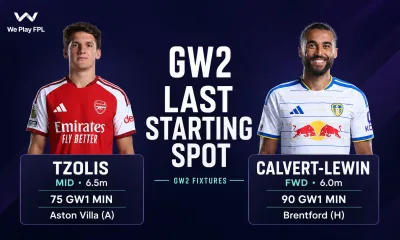
Florian Wirtz played 62 minutes in Gameweek 1. Dominik Szoboszlai played 90, scored and costs 0.5m less. Those facts make the comparison worth watching, but both Liverpool midfielders now face Nott’m Forest at home and Ipswich Town away.
The shared fixtures remove the strongest reason for an instant switch. Wirtz owners would spend a transfer before two favourable matches to buy a player who covers the same schedule. A small rise in team value does not repay that cost on its own.
Make the move if fresh team news points to a clear minutes gap, a settled set-piece role changes the ceiling, or the 0.5m funds a second upgrade. Without one of those gains, keep Wirtz and review the decision with two free transfers in Gameweek 3.
Injury flags create a different decision
Ismaïla Sarr carries a groin injury flag and a 75% chance of playing. His status can justify a Gameweek 2 transfer because availability affects your ability to field a strong XI.
Your bench decides the urgency. Wait for deadline news if a substitute can cover Sarr. Act if his absence would force a weak starter or leave you short. The injury creates a squad problem; the Gameweek 1 score does not.
Keep Sangaré on the watchlist
Mamadou Sangaré offers a tempting route at 5.5m after two assists and 13 defensive contributions in 75 minutes. Brentford visit Leeds in Gameweek 2 and host Sunderland in Gameweek 3, so the schedule supports interest.
One league start cannot settle his minutes or role. Add him to the watchlist and use Gameweek 2 to see whether he keeps his place and plays deeper into the match. Managers planning a Gameweek 3 move can then buy with another line-up and performance to judge.
Preserve the Haaland route
Erling Haaland remains the largest structural decision at 15.5m. Man City visit Crystal Palace in Gameweek 2 before hosting Coventry City in Gameweek 3.
Owners should hold. Non-owners should protect the route they chose before Gameweek 1. Two free transfers can release funds and add Haaland for the Coventry match with less damage to the rest of the squad. Forcing the switch one week sooner can turn a planned premium move into a hit or several unwanted sales.
Make Gameweek 2 buy you information
Roll when your players remain available, their next fixtures still fit the plan and no price change blocks a key route. Transfer when an injury, role loss or squad structure leaves a problem that cannot survive another week.
One extra set of line-ups can answer the questions around Wirtz, Szoboszlai, Sangaré and Sarr. Two free transfers then let you act on those answers with more control.






Fixtures
GW8 captaincy: Haaland or a Chelsea alternative?
Haaland remains our GW8 captaincy choice. Compare his attacking rates with João Pedro and Palmer, including average minutes, fixtures and penalty roles.

Haaland remains our GW8 captaincy choice. Aston Villa away gives managers a reason to consider Chelsea’s home game against Spurs, but we still favour his attacking threat over the alternatives. João Pedro is our first Chelsea challenger; Palmer offers a different route through penalties and midfielder scoring.
You can make this decision with the players you own. A captaincy preference for one deadline needs a stronger justification before you turn it into a transfer.
Haaland leads on attacking involvement
Haaland has produced 0.83 xG/90 and 0.11 xA/90, combining for 0.94 xGI/90. He has averaged 88.4 minutes per match. Among these three candidates, he has the highest rate of expected attacking involvement and enough playing time to support our armband lean.
Villa away carries more uncertainty than a home fixture. We cannot translate Haaland’s season-to-date rates into a promised GW8 score, and City can struggle even with their leading forward available. His underlying attacking case still gives us a reason to keep the captaincy on him.
His popularity should change how you think about rank exposure, rather than how you assess his chance of returning. Captaining a less popular player increases the consequence of the choice in either direction. It does not improve that player’s fixture, role or expected involvement.
João Pedro is the Chelsea challenger
João Pedro faces Spurs at home and has averaged 86.8 minutes per match. His 0.53 xG/90 and 0.05 xA/90 produce 0.58 xGI/90, below Haaland’s rate but above Palmer’s.
We prefer João Pedro of the two Chelsea options if you want to back their attack. He offers the stronger goal-threat rate in this comparison, and the home fixture gives managers a reason to consider him. You still need to accept that you are choosing him over a player with a higher historical attacking rate.
For managers without Haaland, João Pedro is a credible captain from an existing squad. Buying a player for the armband alone requires you to judge the transfer’s cost and your plans beyond GW8 as well.
Palmer brings penalties and midfielder scoring
Palmer has averaged 88.4 minutes per match and holds first place in Chelsea’s penalty order. As an FPL midfielder, he has a different scoring route from the two forwards. Those factors keep him in the conversation against Spurs.
His attacking rates give us less reason to put him first: 0.21 xG/90 and 0.13 xA/90, or 0.34 xGI/90. Penalty priority matters if Chelsea win one; it gives us no certainty that they will.
We lean João Pedro over Palmer within the Chelsea pair. Palmer remains defensible if you place more weight on his penalty role and midfielder scoring, but that choice asks you to look beyond the lower attacking involvement he has recorded so far.
Set the armband, then check the news
Our order is Haaland, João Pedro, then Palmer. All three are available at the time of writing. Recheck late fitness and selection news before the GW8 deadline, Friday 23 October at 17:30 UTC, and choose a vice-captain who can cover an absence.
You can compare players and test captain choices in We Play FPL using the player comparison and squad planner. Treat projected points as one input alongside fixtures and role; they do not guarantee a return.
The expected metrics above describe season-to-date performance. Use them to compare attacking involvement while allowing for the uncertainty of one match.
Chip Strategy
GW8 defender rotation: Muharemović now or Van Hecke later?
Muharemović offers a GW8 entry point, Van Hecke has later home fixtures and Silva provides another route from GW9. Match the purchase to your planned starts.

Tarik Muharemović is our preference among these budget defenders if you need a GW8 starter. Jan Paul van Hecke makes more sense if you can cover this week and want a defender for the home games in GW9 and GW11. Before spending around £5.0m, mark the weeks in which your new signing must play.
That distinction matters on a Wildcard, too. You can afford a tougher opening fixture for a fourth defender if your other three have suitable matches. A defender who has to start this weekend needs a different assessment.
Muharemović for the immediate vacancy
Muharemović costs £5.0m and faces Sunderland away in GW8. We prefer that entry fixture to Van Hecke’s trip to Chelsea or Silva’s visit to Manchester United. The case depends on needing him this week: Leeds then visit Bournemouth, host Spurs and travel to Chelsea.
He has averaged 90.0 min/match. His defensive contributions offer another scoring route alongside a possible clean sheet, with a season-to-date DefCon/90 of 10.43. Treat that as a rate across matches, not a promise that he will reach the scoring threshold in the next one.
His expected goals conceded rate is 1.39 xGC/90, while his attacking involvement stands at 0.11 xGI/90. Those figures support a measured purchase for a specific starting gap. They give little reason to expect regular attacking returns or to buy him without checking the rest of the Leeds run.
Van Hecke for GW9 and GW11 cover
Van Hecke costs £4.9m. Spurs face Chelsea away in GW8, Crystal Palace at home in GW9, Leeds away in GW10 and Ipswich Town at home in GW11.
The two home fixtures make him worth considering if your defence needs help in those weeks. Buy him before GW8 only if you can accept the Chelsea fixture or leave him on the bench without weakening your starting defence. You can wait until GW9 if you have no need to make the move before then.
He has averaged 90.0 min/match, with 1.34 xGC/90 and 0.17 xGI/90. His DefCon/90 is 9.29, below Muharemović’s 10.43. The small gap between their expected goals conceded rates does not establish a clear winner for the next match; their opponents and your planned starts deserve more weight in this choice.
Silva offers a different route from GW9
Silva costs £5.0m and starts with Manchester United away. Bournemouth then host Leeds, visit Ipswich Town and host Nottingham Forest in GW9–11. Consider him if you want a defender you can use across that stretch, rather than someone you need for GW8 alone.
He has averaged 90.0 min/match. His rates are 1.16 xGC/90, 0.24 xGI/90 and 10.43 DefCon/90. He has the lowest expected goals conceded rate and the highest attacking involvement rate of this trio, but those season-to-date measures do not forecast his next three scores. Check the fixtures against your other defenders before paying the extra £0.1m over Van Hecke.
Map the starts before buying
Write down your three intended starting defenders for GW8 through GW11, then identify the vacant slots. You can map future lineups and compare rotation options in We Play FPL before committing the transfer. The planner supports future squad drafts and lineups, while the rotation scout helps assess player combinations across upcoming fixtures.
For a GW8 vacancy, we lean towards Muharemović. For gaps in GW9 and GW11, Van Hecke’s home fixtures warrant a closer look. Silva suits a manager who can cover GW8 and wants another option for the following run.
Keep the cost of the whole defence in view. Spending around £5.0m on a fourth defender needs a purpose if the extra money could improve a regular starter elsewhere. Check availability and the expected starting lineups before the GW8 deadline on 23 October at 17:30 UTC, then choose the player for the weeks you intend to use him.
Fixtures
GW8 forwards: Evanilson or Calvert-Lewin for the next four?
Evanilson has the fixtures; Calvert-Lewin has the higher goal-threat rate. Compare their £6.1m and £6.0m buying cases without chasing recent assists.
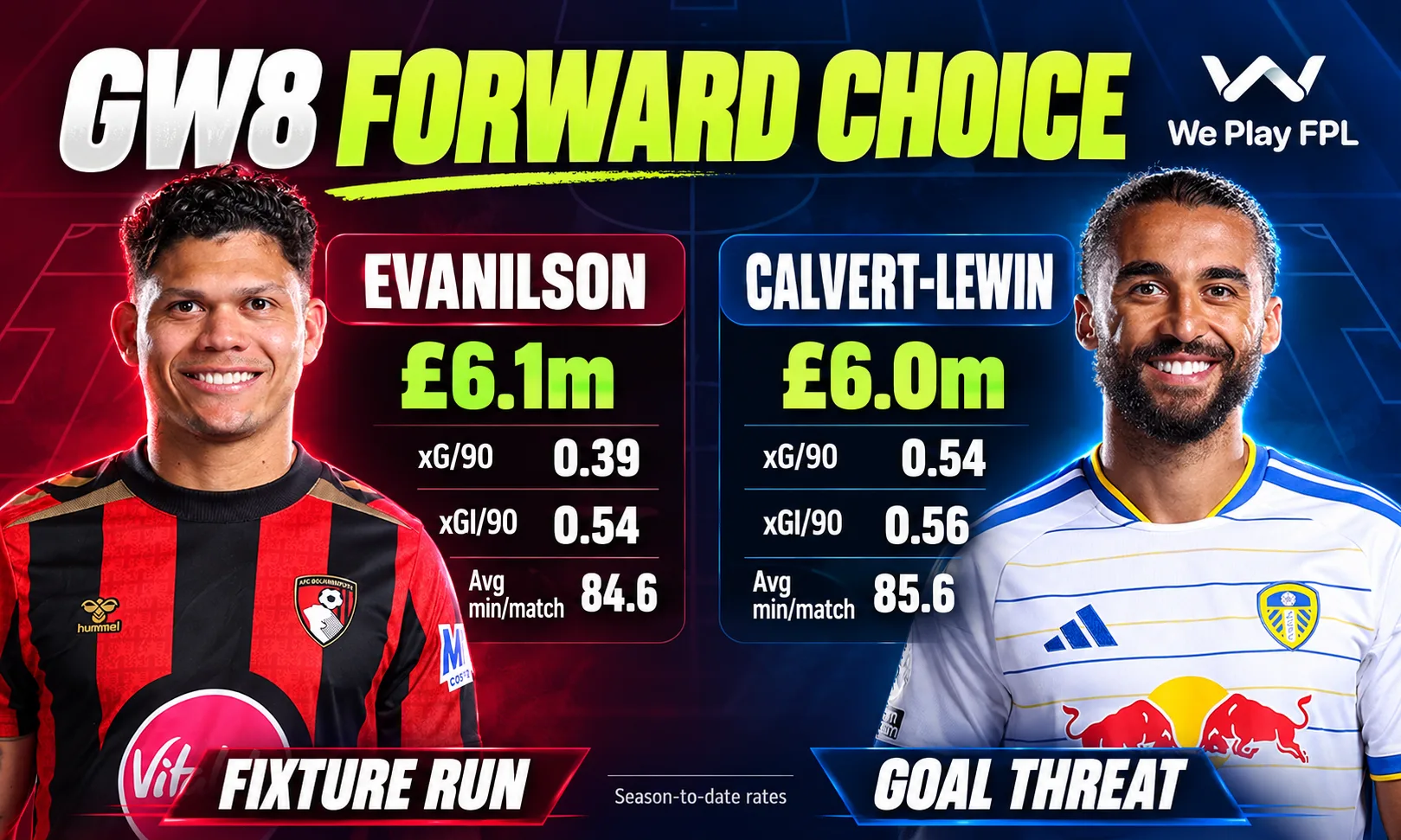
Evanilson and Dominic Calvert-Lewin cost almost the same, but they offer different reasons to buy before GW8. Evanilson has the more appealing fixture run from GW9. Calvert-Lewin has produced the higher goal-threat rate so far.
For a forward you plan to keep through GW11, we favour Evanilson at £6.1m. His four assists need some caution, though. Choose him because Bournemouth face Leeds, Ipswich Town and Nottingham Forest after Manchester United away, rather than assuming the assists will keep arriving at the same pace.
Evanilson: buy for the next four fixtures
Evanilson has two goals and four FPL assists. His 0.97 expected assists give you a reason to temper expectations for that part of his returns. FPL assists and expected assists use different definitions, so the gap does not tell you how many assists he should lose or predict an imminent blank.
His attacking rates give a fuller picture: 0.39 xG/90, 0.15 xA/90 and 0.54 xGI/90, with an average of 84.6 minutes per match. Those season-to-date rates describe his involvement so far; they do not forecast his next score.
The case for buying improves when you look beyond GW8:
- GW8: Manchester United away
- GW9: Leeds home
- GW10: Ipswich Town away
- GW11: Nottingham Forest home
Manchester United away is the first test. If you need a forward this week, assess that fixture alongside the three that follow. If your current forward can start and you have another transfer priority, waiting until GW9 gives you the home match against Leeds as an entry point. A price rise alone would not justify ignoring a more urgent squad problem.
Calvert-Lewin: more goal threat, less creativity
Calvert-Lewin costs £6.0m and has three goals and one assist. He leads this comparison for xG/90, at 0.54 against Evanilson’s 0.39. His 0.02 xA/90 offers much less creative involvement, leaving their combined rates close: 0.56 xGI/90 for Calvert-Lewin and 0.54 for Evanilson.
He averages 85.6 minutes per match. With the two historical minutes averages so close, neither player earns a meaningful advantage on that measure. Future starts and substitutions can still change.
Leeds face Sunderland away in GW8, Bournemouth away in GW9, Spurs home in GW10 and Chelsea away in GW11. Calvert-Lewin deserves consideration if you value his stronger goal-threat rate or need the £0.1m saving to complete another move. Over the full four-match window, we prefer Evanilson’s fixtures.
Let your holding period decide
An owner choosing whether to sell faces a different transfer cost from a manager filling an empty forward slot. If you own Calvert-Lewin, his underlying goal threat gives you a reason to keep him rather than spend a transfer chasing Evanilson’s recent assists. Reassess if availability or role changes.
For a fresh purchase through GW11, Evanilson gets our vote on fixtures. For a short hold, compare the specific matches you expect to use the player in; Bournemouth’s later home games have less value if you plan to sell before them.
You can compare the players and plan future lineups in We Play FPL to see where each forward fits across your intended holding period. Check the whole squad: the £0.1m price difference matters when it changes another transfer or starting spot, and matters much less when the money sits unused.
Before the GW8 deadline at 17:30 UTC on 23 October, recheck fitness and selection news. Buy Evanilson for the fixture window, consider Calvert-Lewin for his goal threat and price, and give an available forward you own a fair comparison before using a transfer.