Manchester City
Opta simulations map out Manchester City’s season under possible points penalties
Opta’s modelling shows how Manchester City’s title, top-four and relegation chances shift under points deductions.


The old saying that the table never lies has rarely felt more complicated than it does now, with Manchester City facing the fallout from an investigation into more than 100 alleged breaches of regulations. While the punishment for previous seasons is still unresolved, attention is also fixed on the current campaign, where a points deduction of some size remains a real possibility.
Opta have modelled a range of outcomes to show how different sanctions could reshape the Premier League picture. Their projections suggest the impact would be felt not only in the title race, but also in the fight for European places and, at the extreme end, even relegation.
With no deduction, City’s title chances stand at 40%. A five-point penalty reduces that to 25%, while 10 points drops it to 15%. At 15 points, the figure falls to 7%, and at 20 points it is down to 3%. A 25-point deduction leaves City with less than a 1% chance of lifting the title.
Even so, City’s prospects of finishing in the top four appear more resilient. Opta give them a 90% chance without a deduction, falling to 62% with 10 points removed and 28% if the sanction reaches 20 points. At 30 points, the chance is only 6%, and at 40 points it is below 1%.
The relegation picture becomes serious only at the harsher end of the scale. Opta put City’s chances of going down at less than 5% with a deduction of 20 points or fewer, and less than 20% at 30 points or fewer. A 40-point penalty would make relegation more likely than not, while 60 points would almost certainly send them down and 74 points would guarantee it.
The Premier League cannot directly relegate Manchester City to the Championship, but it can expel them from the competition. The most realistic route to demotion would be a deduction so severe that it leaves no escape.





Fulham
Haaland’s disallowed goal explained after City and Fulham draw
VAR explained why Haaland’s goal was disallowed as City missed a chance to cut Arsenal’s lead.
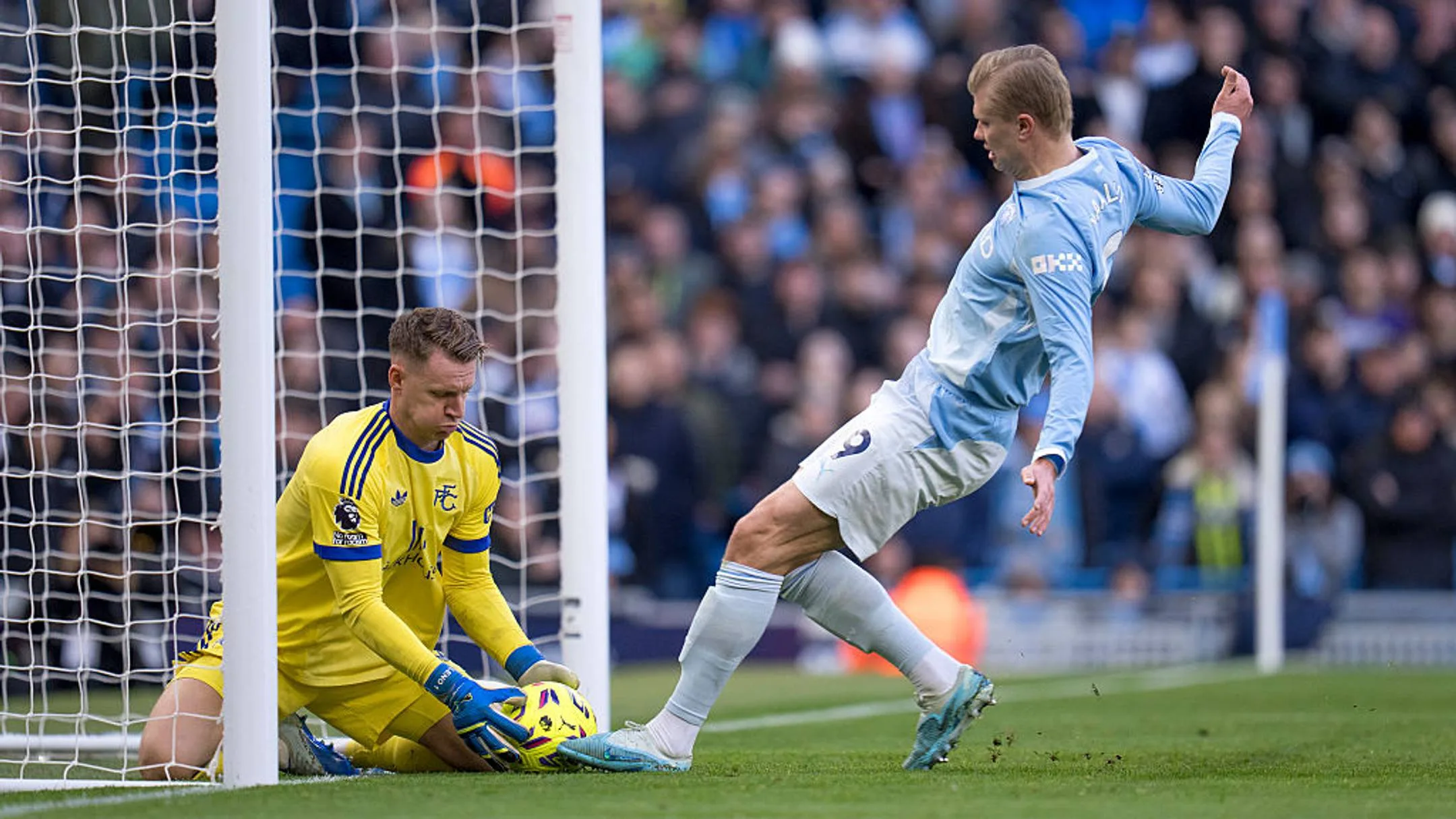
Manchester City were left frustrated after Erling Haaland had a goal ruled out in their 1-1 draw with Fulham, with the decision becoming one of the main talking points of the afternoon.
The initial celebration did not last long. Referee Tom Bramall had already blown for a foul on the Fulham goalkeeper, who appeared to have both hands on the ball, though the question of whether he was fully in control of it has clearly divided opinion.
The Premier League Match Center later set out why the goal was not allowed to stand, posting on X: “The referee’s call of free kick to Fulham and no goal to Manchester City was checked and confirmed by VAR—with the goalkeeper deemed to be in control of the ball.”
The VAR explanation was also made public in full: “The ball is in control between both hands and then is played out of that possession by the attacker, and then into the back of the net.”
City did eventually find an equaliser through Elliot Anderson, who struck a volley into the bottom corner from the edge of the penalty area. Even so, the disallowed Haaland effort would have delivered two additional points had it been given, and it left Maresca visibly unhappy.
“I reviewed the goal after the game. From my point of view, it’s quite clear that it’s not a foul, but I’m not the guy that decides, unfortunately,” Maresca said in his post-match interview.
Asked about Haaland’s reaction during the match, Maresca added: “When they were reviewing the VAR, he was absolutely sure that it was a goal, because I asked him from the touchline.
“He was completely sure that it was a goal but the referee decided for different things.”
The result means City are now four Premier League matches without a win, missing the chance to close the gap on table-toppers Arsenal. Mikel Arteta’s side drew 2-2 at Newcastle United on Saturday and remain six points clear of last season’s runners-up.
Fulham
Manchester City and Fulham meet with different pressures on each side
City need a response, but Fulham arrive organised, unbeaten in four, and improving under Arbeloa.
Manchester City return to Premier League action looking to halt a three-match domestic slide, with the break arriving at an opportune moment for the sky-blue half of Manchester. Their recent run has prompted concern about how exposed they have been in defensive transition, and the need for greater security in midfield has become clear.
Fulham arrive at Etihad Stadium in steadier form. Unbeaten in four, they have moved on from a poor opening spell that left them at the foot of the table. They now sit 15th with 10 points from as many games, though the wider table remains tightly compressed in the middle.
The visitors have begun to look more coherent under Álvaro Arbeloa, who was heavily doubted on arrival. Their improvement has been built on balance, possession and the influence of Alex Iwobi, alongside the creativity of No. 10 Josh King. Recent wins over Coventry City and Ipswich Town were narrow but controlled, and they followed those with 1–1 draws at Aston Villa and against Newcastle United.
City, by contrast, lost three successive Premier League matches before the break, even if a 3–2 Champions League victory over RB Leipzig came in the middle of that slump. Maresca has urged calm and has been given time to reset, but the challenge remains the same: his team must become less vulnerable to the counterattack.
Fulham’s recent numbers suggest they are capable of making this uncomfortable. Just six goals have been scored in their last four league matches, with only two conceded, a reflection of the control they have established. City will need patience if they are to rediscover winning form.
The head-to-head record offers little encouragement for the visitors. Manchester City have won the last 20 meetings, while Fulham have not taken points off them since September 2011 and last beat them in 2009.
Manchester City
What the reported Apollo collapse could mean for Manchester City’s transfer plans
Apollo’s reported collapse leaves Manchester City facing fresh uncertainty over funding and transfers.
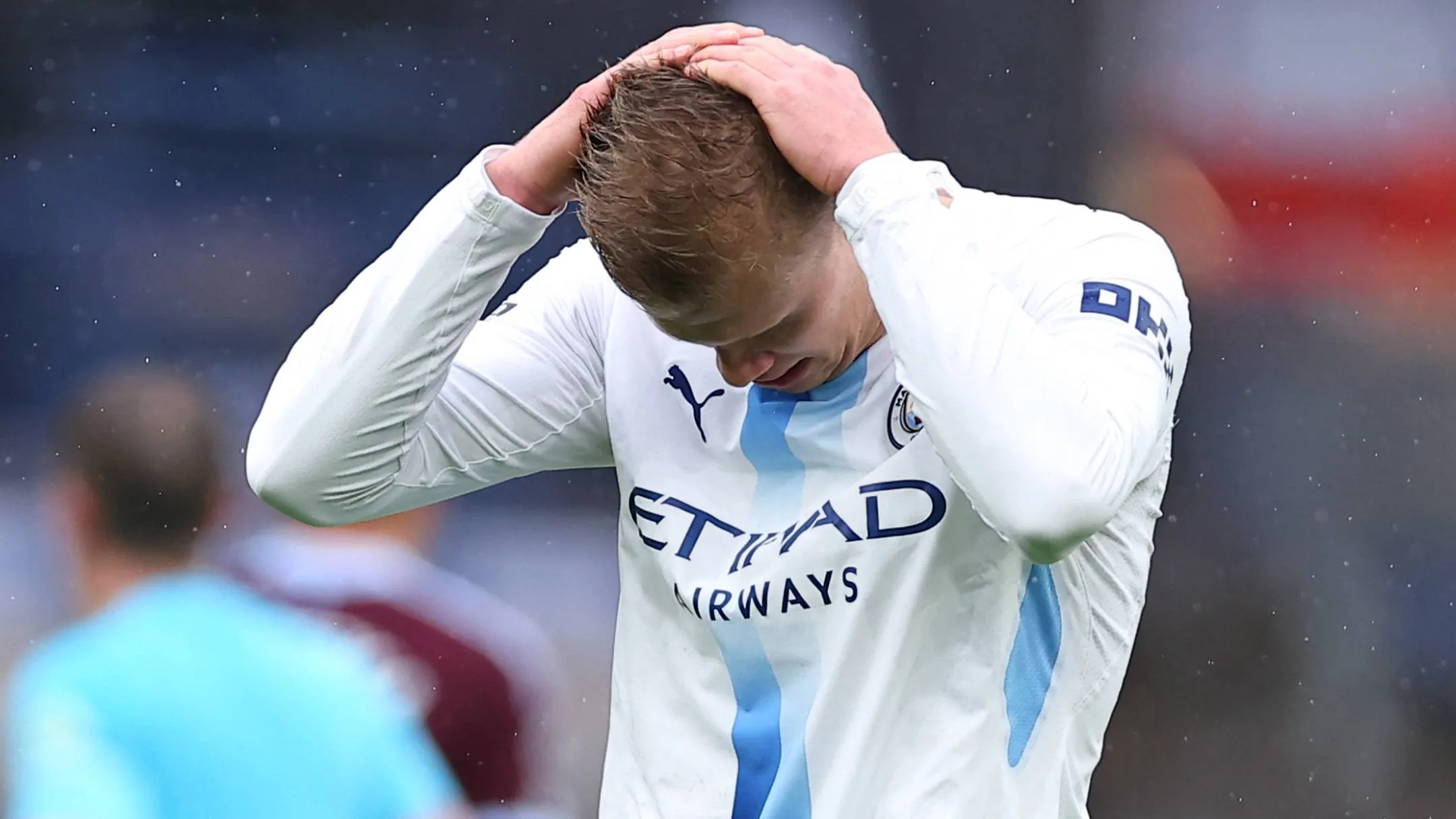
Manchester City’s financial outlook has reportedly taken a significant hit after a proposed $2 billion loan from Apollo Global Management was “scrapped” following the club’s guilty verdict in September over more than 100 breaches of the Premier League’s financial rules.
City have continued to insist on their innocence and have repeatedly pointed to “a comprehensive body of irrefutable evidence.” That material, which is believed to include documents and bank statements, is central to the club’s appeal and underpins the confidence inside the organisation. Outside the club, however, the response has not been nearly as supportive.
According to the Financial Times, Apollo had been preparing to inject $2 billion into the City Football Group, with the agreement understood to be in the “final stages.” The report says the deal collapsed after the guilty finding, even though City’s appeal remains ongoing.
The timing matters. Khaldoon Al Mubarak had only recently claimed that City Football Group and its 11 clubs were worth at least $10 billion, yet the loss of such a large external investment will still be felt across the wider operation.
The reported Apollo package was intended to “refinance existing credit facilities” and provide “extra liquidity”, a phrase that in practical terms points to more flexibility for daily running costs, including money that can be used for potential transfers.
City’s ownership has also put fresh equity into the structure. Sheikh Mansour bin Zayed Al Nahyan was found to have injected £100 million ($131.5 million) into City Football Group through Newton Investment and Development at the end of October. It is not clear whether that move was a direct reaction to the lost Apollo funding, though that is how it has been framed.
Even so, the amount is far smaller than the sum Apollo had been expected to provide. The Financial Times points to rising “uncertainty” around the club’s financial future as the Premier League case continues.