Fixtures
GW11 FPL defenders: Van Hecke or Muharemović at £5.1m?
Van Hecke offers the stronger immediate fixture run at £5.1m. Muharemović has the higher defensive-contribution rate, but needs a rotation plan for tough away games.

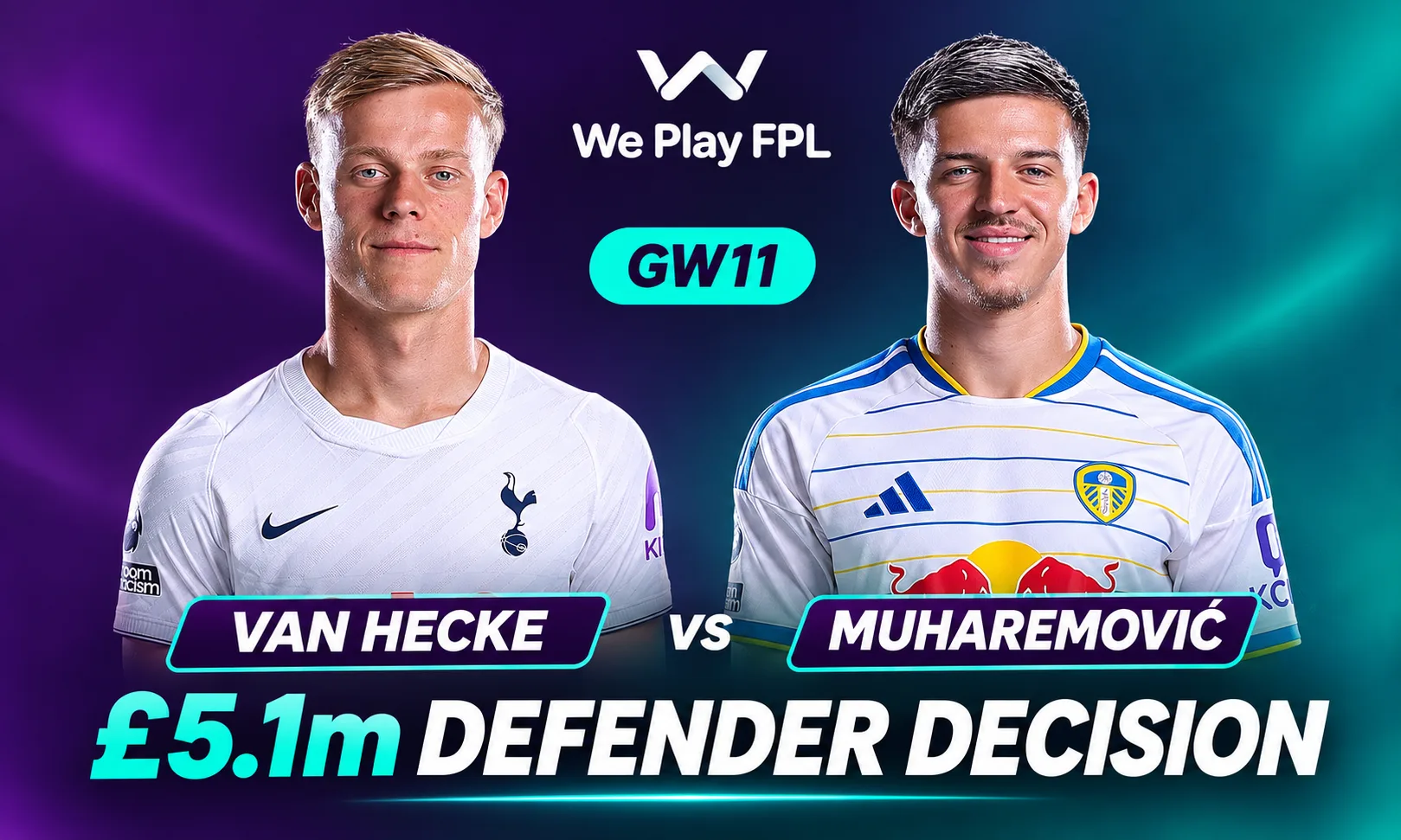
Van Hecke is our preferred £5.1m defender to buy for a starting place in GW11. Spurs face Ipswich at home, Sunderland away and Fulham at home over the next three Gameweeks. He also has the stronger season-to-date attacking involvement of this pair.
Muharemović makes more sense if you can rotate him. The Leeds defender has a higher defensive-contribution rate, but Chelsea away in GW11 and Manchester City away in GW13 make him a harder purchase for a squad that needs an immediate starter. At the same price, choose around the matches in which you will use him.
Compare the routes to points
Both players are FPL defenders, both are available, and both average 90.0 minutes per match across their played appearances this season. You do not have a historical average-minutes advantage to separate them.
- Van Hecke: £5.1m; expected goal involvement, or xGI/90, of 0.24; expected goals conceded, or xGC/90, of 1.19; defensive contributions, or DefCon/90, of 8.50; average 90.0 min/match.
- Muharemović: £5.1m; xGI/90 of 0.08; xGC/90 of 1.26; DefCon/90 of 11.20; average 90.0 min/match.
Van Hecke has the higher attacking expected-performance rate. That supports buying him for a combination of clean-sheet opportunities and attacking returns, though you should allow for matches in which a centre-back contributes little in attack.
Muharemović offers more through defensive contributions. His 11.20 DefCon/90 gives you a reason to consider him beyond clean sheets. You still need to judge that rate alongside the fixtures: an average does not show how often he earns the defensive-contribution reward, and it does not guarantee points in the next match.
These expected metrics describe season-to-date performance. Treat them as evidence for the comparison rather than a forecast. Van Hecke’s lower xGC/90 adds to his case, but the difference between 1.19 and 1.26 is too small to make a confident next-match clean-sheet call on its own. DefCon/90 measures observed defensive contributions; it is separate from the expected metrics.
Van Hecke has the easier first three starts
Buy Van Hecke if you want to start the new defender through GW13. Ipswich at home, Sunderland away and Fulham at home give you a clearer immediate plan than Muharemović’s alternating home and away schedule.
Limit the favourable-run argument to those first three matches. Van Hecke faces Arsenal at home in GW14, Hull away in GW15 and Liverpool away in GW16. Arsenal at home deserves a separate decision; avoid treating the first four fixtures as one uninterrupted green run.
You can assess those later starts alongside your other defenders with the We Play FPL player comparison, which combines performance statistics and upcoming fixtures. Check the games you intend to start each player before choosing between their season averages.
Muharemović needs a rotation partner
Muharemović’s next six are Chelsea away, Coventry at home, Manchester City away, Ipswich at home, Liverpool away and Fulham at home. You can target the home matches if another defender covers the tougher trips.
That makes him a viable purchase for a squad with suitable rotation. A higher defensive-contribution rate can help his scoring case in difficult games, but you should be comfortable starting him in those games if your cover becomes unavailable. Buying him while assuming you can bench him through three away fixtures requires more planning than buying Van Hecke for the next three starts.
Our GW11 choice
For a fresh purchase, we favour Van Hecke for GW11–13. His immediate fixtures and greater attacking involvement suit a manager who needs the transfer to improve the starting XI now. Reassess before Arsenal in GW14.
Choose Muharemović if you value his defensive-contribution output and can name the defender who will cover the difficult away matches. If you own either player, this comparison alone does not justify spending a transfer to switch between them. Check confirmed availability before the 21 November deadline at 11:00 UTC.






Fixtures
GW10 Calvert-Lewin injury doubt: hold or move to Evanilson?
Hold Calvert-Lewin if the fitness update supports a start and your cover works. For a fresh forward purchase, we prefer Evanilson at £6.4m.

Keep Calvert-Lewin if the final fitness update supports a start and you have cover you trust. For a fresh forward purchase, we prefer Evanilson. You can buy the Bournemouth forward without taking on Calvert-Lewin’s unresolved foot problem, while an existing owner has more reason to wait before spending a transfer.
Calvert-Lewin costs £6.1m and carries a foot-injury flag ahead of Leeds’ home match against Spurs. Evanilson costs £6.4m, has no current injury flag, and visits Ipswich in GW10. That £0.3m difference is a buying-price comparison: check your own selling value before planning the switch.
Calvert-Lewin owners can wait for the fitness update
The current flag gives Calvert-Lewin a 75% chance of playing. Treat that as unresolved availability, with no guarantee of a start or a full match. Owners should wait for the final update before deciding whether their squad needs a replacement.
Leeds host Spurs in GW10, visit Chelsea in GW11, then host Coventry in GW12. You can retain Calvert-Lewin for the two home fixtures if his fitness allows it, with a separate lineup decision for Chelsea away. Selling him before the injury picture clears could mean spending a transfer on a forward you would want to start again in GW12.
Check the substitute who would cover him. A playable bench option makes a hold easier to accept, but you still face the risk of Calvert-Lewin appearing for a short spell and blocking an automatic substitution. Managers who need him to complete their XI have more reason to consider a sale if the final update leaves his participation in doubt.
Evanilson is our preference for a new purchase
Evanilson offers a route into Bournemouth’s attack at £6.4m. After Ipswich away, he faces Nottingham Forest at home in GW11 and Fulham away in GW12. A new buyer can assess that run without inheriting an injury decision before the first match.
His season-to-date attacking rate is 0.55 expected goal involvements per 90 minutes, compared with Calvert-Lewin’s 0.48 xGI/90. Evanilson averages 83.7 min/match; Calvert-Lewin averages 85.9 min/match. Those are played averages, so Calvert-Lewin’s figure does not tell you how long he will play while managing the foot problem.
The difference in xGI/90 supports a preference for Evanilson, rather than a claim that he will outscore Calvert-Lewin this week. Both forwards have offered attacking involvement. For a new purchase, we favour Evanilson’s combination of availability and the upcoming fixtures; an owner considering a sale must weigh the transfer cost too.
Check the next three lineups before switching
Compare your XI with Calvert-Lewin available, your XI with him absent, and the team you could field after buying Evanilson. You can test those future lineups in We Play FPL before using a transfer. Include the GW11 and GW12 selections so you can see whether the move improves more than the immediate injury cover.
Use the switch to solve a starting-XI problem. If a positive fitness update lets you start Calvert-Lewin with confidence, keeping him preserves a transfer for another position. If he cannot play and your substitute would leave you short, Evanilson is a sensible replacement, provided you can afford him and have room within the club limit.
Make the final call before the GW10 deadline on Friday 6 November at 18:30 UTC. Our preference is to hold a fit Calvert-Lewin as an owner and buy Evanilson for a vacant forward slot. An unresolved injury that leaves your XI exposed is the reason to turn that buying preference into a sale.
Differentials
GW9 budget midfield: Tonali, Enciso or Rudoni?
Tonali offers playing time and defensive contributions, Enciso more attacking involvement, and Rudoni a saving. Match the choice to your planned starts.

Pick your cheapest playable midfielder around the job he needs to do. At £5.3m, Sandro Tonali offers a strong playing-time record and more defensive contributions than Julio Enciso or Jack Rudoni. Enciso gives you more attacking involvement for another £0.2m. Rudoni costs £4.9m, with a shorter average appearance to weigh against the saving.
We would consider Tonali for a slot that needs dependable playing time, Enciso when attacking returns take priority, and Rudoni when the extra cash improves another starter. Each choice involves a compromise. Decide your planned starts before spending a transfer on a small price difference.
Tonali: playing time with a defensive contribution caveat
Tonali has averaged 87.1 minutes per match for Spurs. His 10.07 defensive contributions per 90 minutes, or DefCon/90, exceed Enciso’s 6.84 and Rudoni’s 7.95. He has the strongest case of the three if you want playing time and a route to extra points through defensive work.
Keep your expectations measured. Across his last six league matches, Tonali recorded 12, 11, 11, nine, 15 and 12 defensive contributions. Those near misses show why you should allow for matches without a defensive contribution return. A season average cannot tell you which side of the scoring threshold he will finish on in a particular fixture.
He also has the lowest attacking involvement rate in this comparison: 0.21 expected goal involvements per 90 minutes, or xGI/90. You accept less attacking threat in exchange for his playing-time record and defensive contribution rate.
Spurs host Crystal Palace in GW9, visit Leeds in GW10 and host Ipswich Town in GW11. Tonali fits a plan that needs cover across those weeks, provided the final team news supports his selection. His average playing time describes his record so far; it guarantees no future start.
Enciso: pay £0.2m for more attacking involvement
Enciso costs £5.5m and has averaged 80.6 minutes per match for Ipswich Town. At 0.46 xGI/90, he has offered more than twice Tonali’s attacking involvement rate. You pay £0.2m extra for that route to returns while accepting a lower defensive contribution rate and less playing time per appearance.
His immediate fixtures are Hull City away in GW9 and Bournemouth at home in GW10, followed by Spurs away in GW11. Check whether you need him for that third fixture before treating him as a purchase for the whole run.
We would lean towards Enciso over Tonali if the £0.2m leaves your other plans intact and you want attacking potential from this midfield slot. Expected goal involvements measure season-to-date performance, so avoid reading 0.46 as a forecast for the next match.
Rudoni: the saving comes with a playing-time trade-off
Rudoni costs £0.4m less than Tonali and £0.6m less than Enciso. He has averaged 69.4 minutes per match for Coventry City, alongside 0.52 xGI/90 and 7.95 DefCon/90.
His attacking involvement rate leads this group, but he has played fewer minutes per appearance. Compare the time you expect him to spend on the pitch as well as his per-90 threat. Do not add a permanent penalty role to his buying case while that role remains uncertain.
Coventry host Sunderland in GW9, visit Everton in GW10 and host Crystal Palace in GW11. Rudoni makes sense when you can use those home fixtures and spend the saving on another starter. A cheap substitute you seldom select may be enough; a midfielder you need for several consecutive starts deserves a closer look at playing time.
Choose the slot before making the transfer
All three have the official FPL midfielder classification and current available status. Availability alone confirms no place in the starting XI. Recheck the team news before the GW9 deadline.
Map out the starts you need and compare the midfield options in We Play FPL, where you can review player statistics and upcoming fixtures side by side. Use that comparison to test whether the saving improves your intended XI.
Our preference depends on the squad: Tonali for his playing-time record and defensive work, Enciso for more attacking involvement at a modest extra cost, or Rudoni to release money for a specific upgrade elsewhere. Keep your current enabler if a sideways move leaves the rest of your team no better off.
Chip Strategy
GW9 Liverpool defence: Jacquet, Araujo or Van Dijk?
Jacquet offers Liverpool defensive value at £5.1m; Van Dijk has the stronger playing-time record. Compare the price tiers and plan your starts from GW10.

Jeremy Jacquet is our first Liverpool defender to consider if you want to keep the cost down. At £5.1m, he costs £0.3m less than Ronald Araujo and £1.3m less than Virgil van Dijk. His playing-time record and defensive contribution rate make that saving worth taking seriously.
For a new purchase, we would reassess after Arsenal at home in GW9. You can then decide whether Liverpool’s GW10–14 fixtures suit the weeks you need a defender. Van Dijk offers the stronger playing-time record if you have room for £6.4m; Araujo needs a clearer reason for the extra spend over Jacquet.
Jacquet offers the cheaper route
Jacquet has averaged 85.3 minutes per match, with 9.37 defensive contributions per 90. Araujo has averaged 61.6 minutes per match and 7.85 defensive contributions per 90. Neither average promises a future start, but Jacquet has given owners more playing time so far.
The attacking numbers offer little reason to pay up for Araujo. Jacquet has 0.07 expected goal involvements per 90 (xGI/90), compared with Araujo’s 0.02. Both rates are low, so we would buy either for the defensive role and budget fit rather than an expectation of regular attacking returns.
Araujo has the lower expected goals conceded rate: 0.97 xGC/90 against Jacquet’s 1.16. That deserves a place in the comparison, but the players have spent different amounts of time on the pitch. We would not treat it as proof that choosing Araujo gives you a better chance of a clean sheet in the next match.
Our lean is Jacquet when choosing between the two at current prices. Fresh selection news could change that call. Paying another £0.3m makes more sense if you can identify a role or playing-time advantage that the current record does not show.
Van Dijk costs £1.3m more for a stronger minutes record
Van Dijk has averaged 90.0 minutes per match. That is the strongest record of the three, alongside 9.75 defensive contributions per 90. His 1.20 xGC/90 and 0.05 xGI/90 do not establish a large expected-performance advantage over Jacquet.
At £6.4m, we would choose Van Dijk when you can afford the premium and place a high value on his playing-time record. You still need to check availability and selection news; a historical average cannot guarantee his next start.
For a tighter budget, Jacquet leaves £1.3m available elsewhere. Compare what you gain from that saving with the extra playing-time confidence you want from Van Dijk before committing to either player.
Plan the starts from GW10
Liverpool’s schedule after Arsenal includes three away matches in five:
- GW10: Crystal Palace away.
- GW11: Man Utd at home.
- GW12: Everton away.
- GW13: Sunderland at home.
- GW14: Chelsea away.
You need a plan for that whole stretch. A lower price helps, but you may still want another defender available for selected away fixtures. You can compare Liverpool’s defensive options in We Play FPL using player statistics and upcoming fixtures, then map out the starts in the planner.
We would shortlist Jacquet for value and Van Dijk for the stronger playing-time record, then revisit the choice after GW9 with fresh team news. Araujo’s lower xGC/90 merits attention, but his shorter average appearances and higher price leave us preferring Jacquet for the cheaper slot. These season-to-date rates describe past performance; they do not predict clean sheets or attacking returns.