FPL
FPL Price Changes: Early Risers Catching Managers’ Eyes
Three players rise in FPL after big GW1 hauls…


The first price changes of the new Fantasy Premier League season are in, and they’re all on the way up. Three players have earned early price rises after standout opening-week performances, and there are no falls to report. Let’s break down the movers, their fixtures, and whether you should be considering them for your team.
Reijnders (£5.6m, Man City)
It didn’t take long for Reijnders to make his mark at Manchester City. On his Premier League debut against Wolves, the midfielder picked up a 10-point haul in City’s 4-0 win. That was enough to spark a rush of transfers and push his price up to £5.6m.
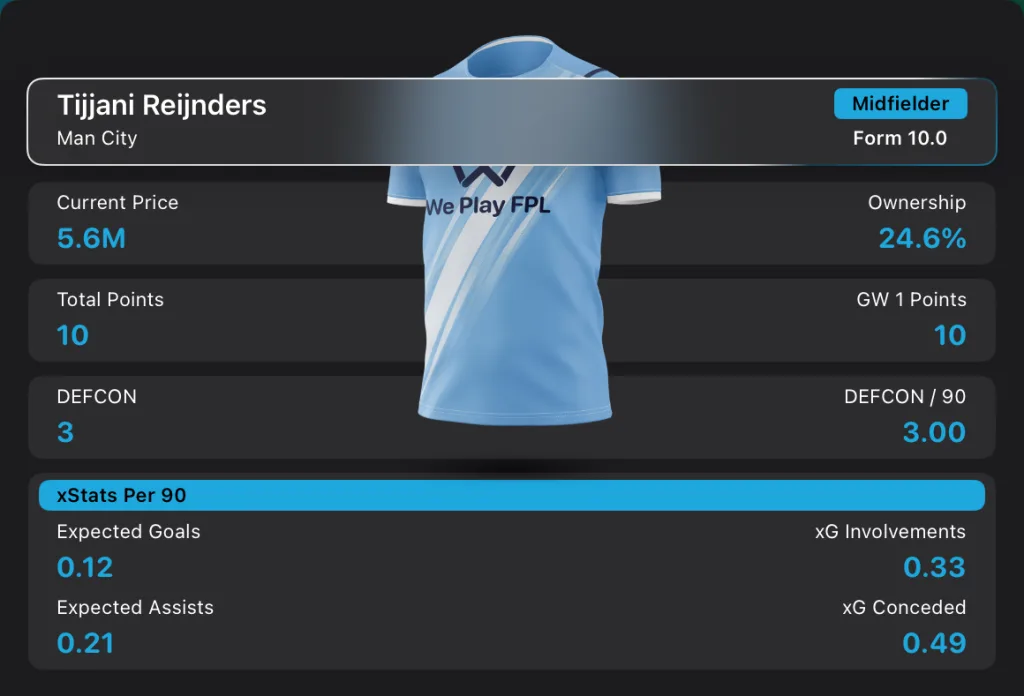
At almost 25% ownership, the market clearly likes what it’s seen. But there’s a note of caution. City’s upcoming run includes Tottenham, Manchester United, and Arsenal in the next four. There’s also a kinder-looking home fixture against Brighton mixed in. He looks like a decent budget enabler in midfield, but you need to weigh his potential against those tough fixtures.
Ekitiké (£8.6m, Liverpool)
Liverpool’s new forward has wasted no time in grabbing attention. Ekitiké delivered an 11-point return in just 71 minutes of his debut, scoring in the 4-2 win over Bournemouth. That immediate impact has seen his price climb to £8.6m.
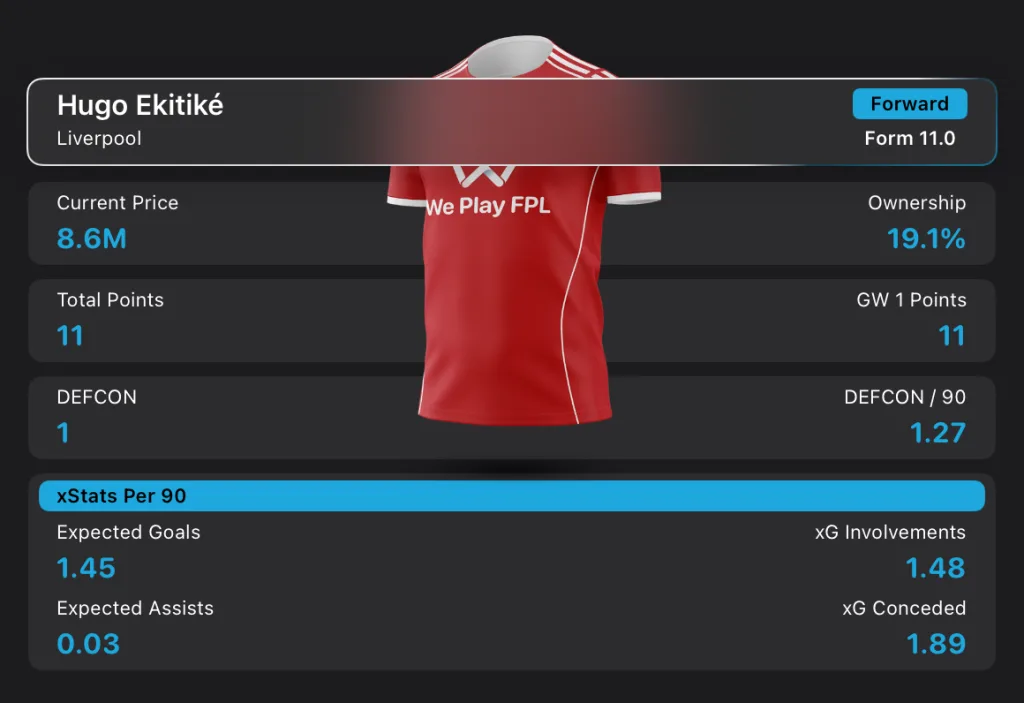
Liverpool’s fixtures are mixed but appealing for a forward in form. Newcastle away, Arsenal at home, and Burnley away are next up. The Arsenal clash may be tricky, but the other two give him chances to keep the momentum going. At this price point, managers will be asking whether he can become a reliable forward option alongside the big names.
Semenyo (£7.1m, Bournemouth)
On the other side of that same match, Semenyo was the standout for Bournemouth despite the defeat. The midfielder picked up a huge 15-point return in Gameweek 1, which included a goal and maximum bonus. His price has risen to £7.1m with 9.6% ownership so far.
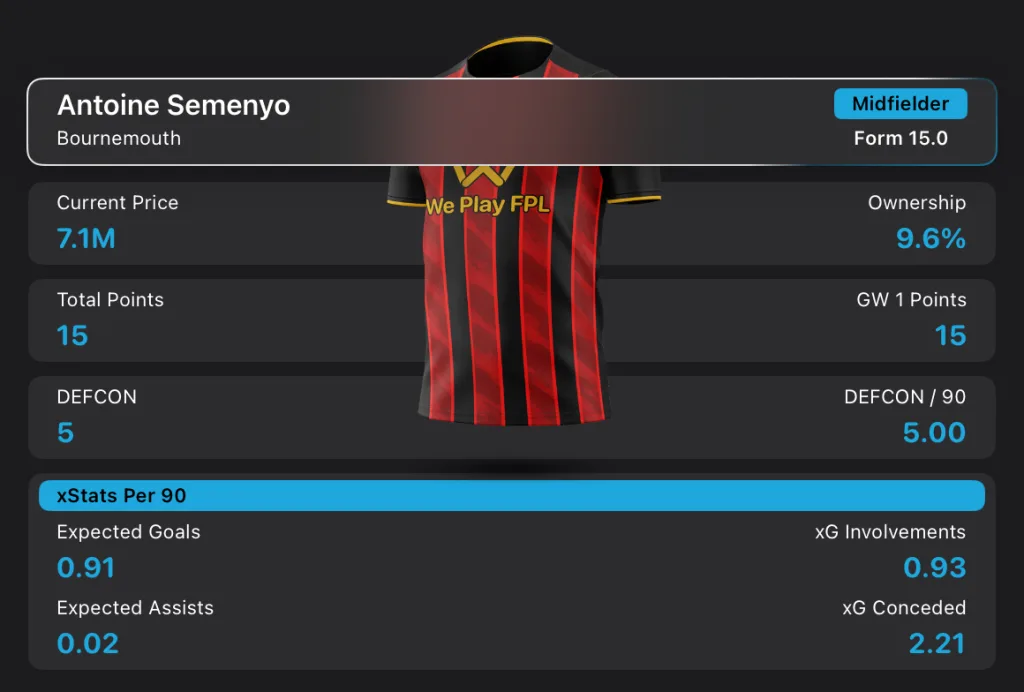
Bournemouth’s upcoming fixtures look manageable. They face Wolves at home and Brighton away in the next three, although there’s also a tough trip to Tottenham. Semenyo has shown he can deliver even against strong opposition, and at this price, he could be a value pick if Bournemouth can build momentum.
No Price Falls
For now, no players have dropped in value, meaning it’s only the early risers shaping the market.
Final Thoughts
The first round of price changes is always telling. Managers are quick to jump on bandwagons, and these three players have delivered early points to justify the hype. Reijnders looks like a budget-friendly option but with tough fixtures, Ekitiké has the potential to become a strong Liverpool forward pick, and Semenyo could be a hidden gem if he keeps up his form.
As always, timing your transfers is key. Don’t rush in unless they genuinely fit your squad and strategy.
Want help spotting the next price rise before it happens? Download the We Play FPL app today. You’ll get transfer planning tools, player comparison features, and points predictions to help you stay ahead of the market.
May your arrows be green. Happy managing!







Chip Strategy
GW10 Rice: is he worth a £7.4m transfer?
Rice has five assists, but his £7.4m buying case needs a closer look. Weigh his creativity, goal threat and fixtures before using a GW10 transfer.

Keep Declan Rice for Hull at home if you own him and have a more urgent transfer to make. Buying him at £7.4m needs a stronger reason than his five assists and 47 points. You would be paying for a midfielder whose creativity has produced more returns than his underlying attacking numbers suggest.
Rice can reward owners against Hull. The concern for a new buyer is the price, his limited goal threat and the fixtures that follow. Before spending a transfer, decide whether you want him beyond GW10.
Five assists need some context
Rice has five assists against 2.01 expected assists this season. He has created chances, but projecting another five assists from the same level of creation would be optimistic. Expected assists describe the chances he has created; they do not forecast his next result or require him to blank to make up the difference.
His per-90 attacking rates sharpen the buying decision: 0.05 xG/90, 0.24 xA/90 and 0.29 xGI/90. He has averaged 84.4 minutes per match. At that level of goal threat, you are relying on his creativity for much of his attacking upside. He has scored no league goals so far.
Those season-to-date performance rates help explain how he has played. They are not a points prediction for Hull, and the average playing time does not guarantee his next start or workload.
Check the floor beneath the returns
Rice has collected seven bonus points. Those points count for his owners, but you should judge the next purchase on the scoring routes available in the coming matches. Budgeting for bonus alongside each assist would overstate the security of his returns.
His 8.76 DefCon/90 also gives little reason to assume a dependable cushion of defensive-contribution points. That rate measures defensive actions across his playing time; it does not guarantee threshold points in an individual fixture. Use the verified 84.4 average minutes per match alongside it, then leave room for variation in both workload and involvement.
Rice remains capable of a useful return. At £7.4m, a buyer needs to want his creative role enough to accept the limited goal threat, rather than treating his past points as a reliable weekly floor.
Look beyond Hull at home
Arsenal host Hull in GW10, then visit Newcastle in GW11 and host Manchester City in GW12. A transfer for Hull alone leaves you with another decision at the next deadline.
If you are considering Rice, compare players and upcoming fixtures in We Play FPL before committing the budget. Check how the purchase fits your midfield through Newcastle and Manchester City, including whether you would still choose him if you could not use another transfer on that slot.
Existing owners can give him the Hull match while fixing a weaker starting position. For a fresh purchase, favour a clear improvement to your XI over chasing the assists you missed. Rice makes sense if you want his creativity across the holding period and can accept the risk of quieter weeks. His recent returns alone are too thin a reason to spend £7.4m.
Fixtures
GW10 Calvert-Lewin injury doubt: hold or move to Evanilson?
Hold Calvert-Lewin if the fitness update supports a start and your cover works. For a fresh forward purchase, we prefer Evanilson at £6.4m.
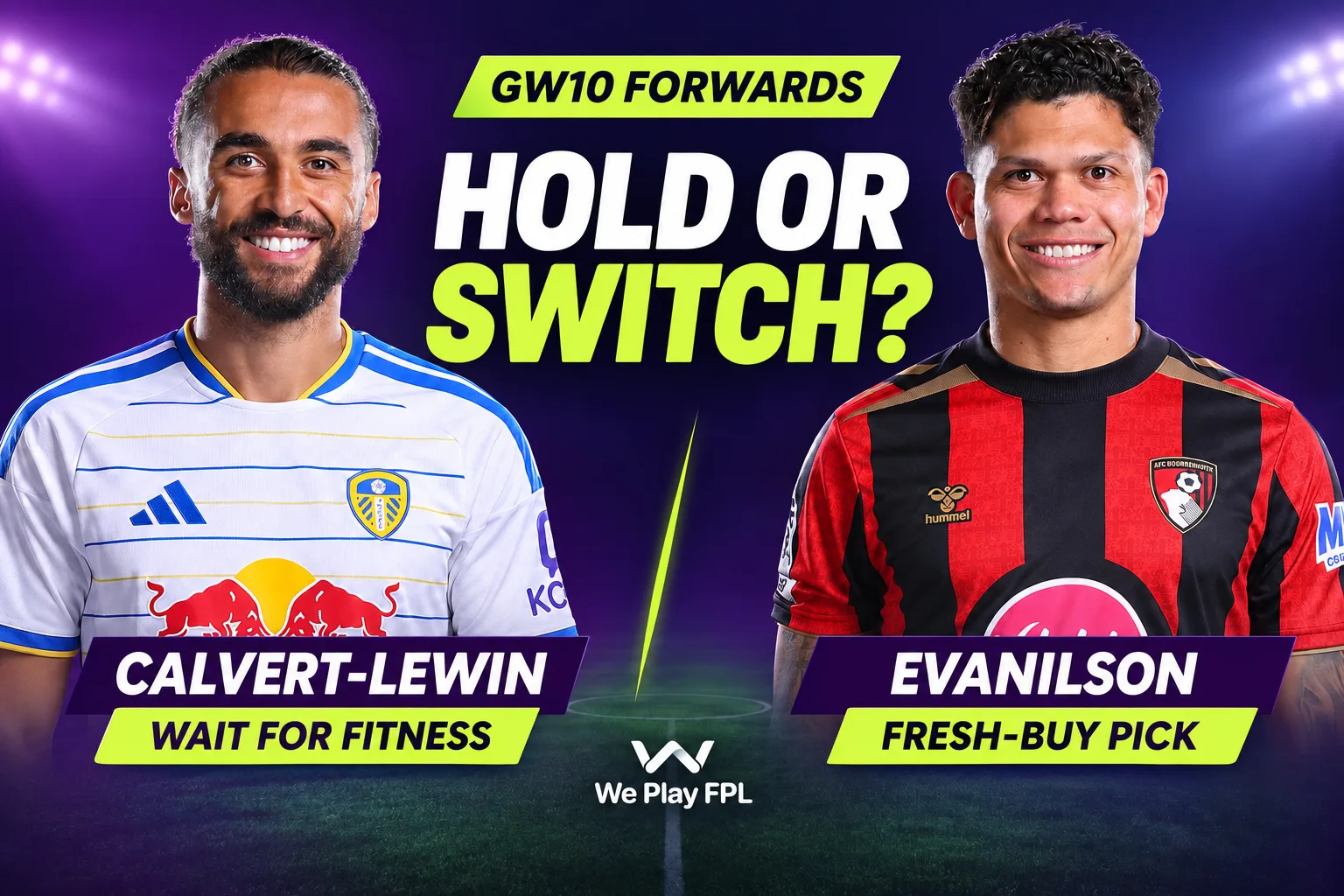
Keep Calvert-Lewin if the final fitness update supports a start and you have cover you trust. For a fresh forward purchase, we prefer Evanilson. You can buy the Bournemouth forward without taking on Calvert-Lewin’s unresolved foot problem, while an existing owner has more reason to wait before spending a transfer.
Calvert-Lewin costs £6.1m and carries a foot-injury flag ahead of Leeds’ home match against Spurs. Evanilson costs £6.4m, has no current injury flag, and visits Ipswich in GW10. That £0.3m difference is a buying-price comparison: check your own selling value before planning the switch.
Calvert-Lewin owners can wait for the fitness update
The current flag gives Calvert-Lewin a 75% chance of playing. Treat that as unresolved availability, with no guarantee of a start or a full match. Owners should wait for the final update before deciding whether their squad needs a replacement.
Leeds host Spurs in GW10, visit Chelsea in GW11, then host Coventry in GW12. You can retain Calvert-Lewin for the two home fixtures if his fitness allows it, with a separate lineup decision for Chelsea away. Selling him before the injury picture clears could mean spending a transfer on a forward you would want to start again in GW12.
Check the substitute who would cover him. A playable bench option makes a hold easier to accept, but you still face the risk of Calvert-Lewin appearing for a short spell and blocking an automatic substitution. Managers who need him to complete their XI have more reason to consider a sale if the final update leaves his participation in doubt.
Evanilson is our preference for a new purchase
Evanilson offers a route into Bournemouth’s attack at £6.4m. After Ipswich away, he faces Nottingham Forest at home in GW11 and Fulham away in GW12. A new buyer can assess that run without inheriting an injury decision before the first match.
His season-to-date attacking rate is 0.55 expected goal involvements per 90 minutes, compared with Calvert-Lewin’s 0.48 xGI/90. Evanilson averages 83.7 min/match; Calvert-Lewin averages 85.9 min/match. Those are played averages, so Calvert-Lewin’s figure does not tell you how long he will play while managing the foot problem.
The difference in xGI/90 supports a preference for Evanilson, rather than a claim that he will outscore Calvert-Lewin this week. Both forwards have offered attacking involvement. For a new purchase, we favour Evanilson’s combination of availability and the upcoming fixtures; an owner considering a sale must weigh the transfer cost too.
Check the next three lineups before switching
Compare your XI with Calvert-Lewin available, your XI with him absent, and the team you could field after buying Evanilson. You can test those future lineups in We Play FPL before using a transfer. Include the GW11 and GW12 selections so you can see whether the move improves more than the immediate injury cover.
Use the switch to solve a starting-XI problem. If a positive fitness update lets you start Calvert-Lewin with confidence, keeping him preserves a transfer for another position. If he cannot play and your substitute would leave you short, Evanilson is a sensible replacement, provided you can afford him and have room within the club limit.
Make the final call before the GW10 deadline on Friday 6 November at 18:30 UTC. Our preference is to hold a fit Calvert-Lewin as an owner and buy Evanilson for a vacant forward slot. An unresolved injury that leaves your XI exposed is the reason to turn that buying preference into a sale.
Chip Strategy
GW10 captaincy: Haaland or Gabriel for the armband?
Haaland leads our GW10 captaincy picks, with Gabriel at home to Hull the alternative. Compare their scoring routes and check Calafiori’s workload.
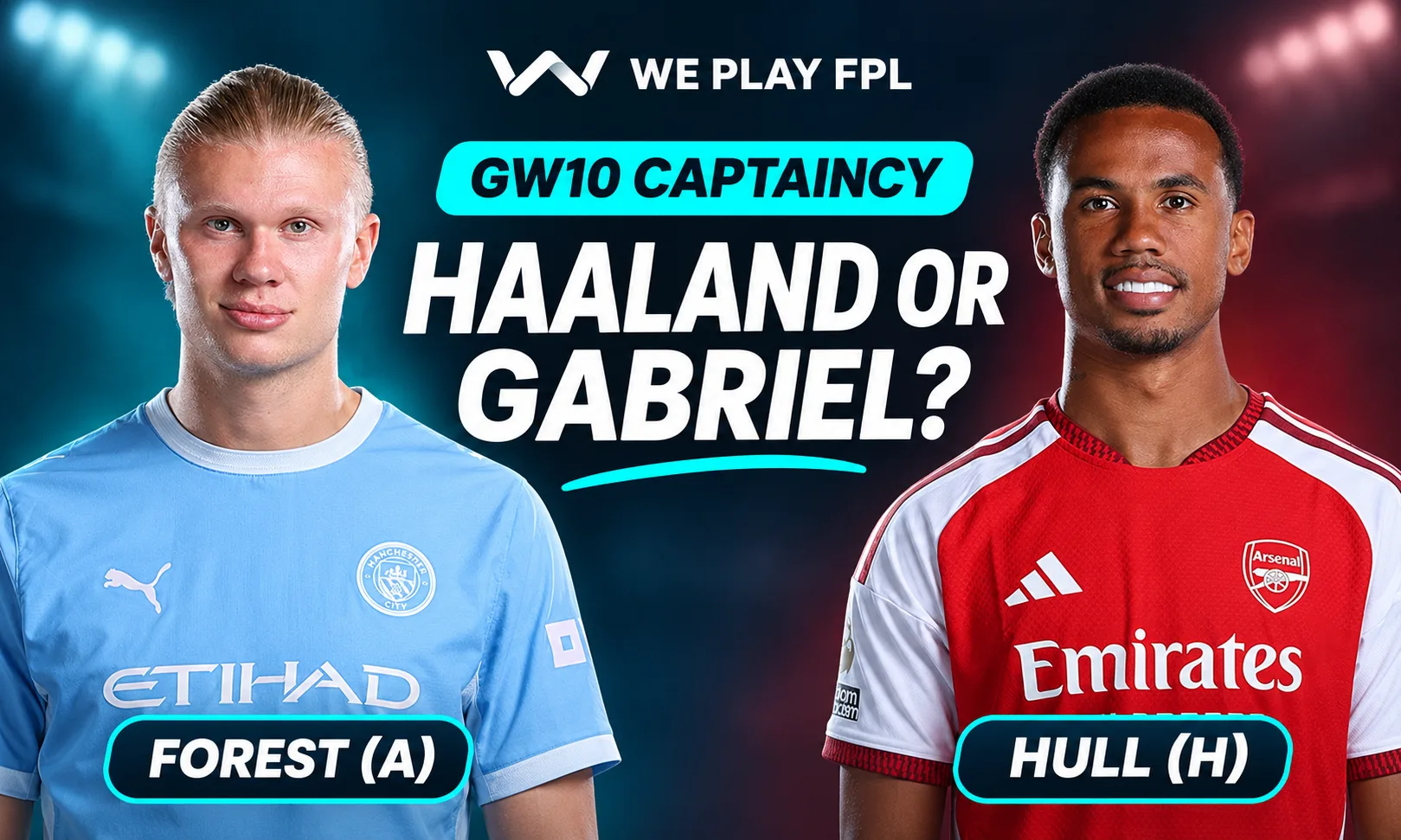
Haaland gets our GW10 captaincy vote away to Forest. Gabriel is a credible alternative at home to Hull for managers willing to back Arsenal’s clean-sheet prospects and his attacking threat. Choose between those routes after checking selection news, with Haaland our first choice if you own both.
Gabriel’s home fixture deserves consideration. His season-long playing time and several ways to score make him more than a punt on a header. The trade-off is the weight you place on a defender’s clean sheet against Haaland’s stronger attacking involvement.
Haaland offers the stronger attacking case
Haaland averages 88.8 min/match and records 0.74 xG/90, with 0.84 xGI/90 once expected assists are included. At £15.8m, he takes a large share of the squad budget, but owners can captain him without spending a transfer or changing their team structure.
Manchester City visit Forest in GW10. The away venue gives Gabriel’s home match some appeal, though choosing Haaland still means backing the player with the more substantial attacking record in this comparison. His goal threat is the main reason for our preference.
These rates describe season-to-date performances. A 0.84 xGI/90 figure is neither a GW10 points prediction nor a promise of a goal involvement. Use it to judge the attacking case, then check whether new fitness or selection information changes your confidence before the deadline.
Gabriel gives you a different route to returns
Gabriel costs £8.0m and averages 90.0 min/match. He has 0.80 xGC/90 and 0.19 xGI/90, including 0.16 xG/90. Against Hull at home, managers can back the combination of defensive returns and his threat from set pieces.
His 9.00 DefCon/90 adds context to the defensive case. It measures defensive contributions per 90 minutes; it does not guarantee contribution points in this match. The same caution applies to clean sheets: xGC/90 measures expected goals conceded while he is on the pitch, rather than the chance of shutting out Hull.
Gabriel’s attacking rate sits below Haaland’s. That does not settle the captaincy by itself because defenders have other scoring routes, but it explains what you accept by choosing him. You put more weight on Arsenal keeping a clean sheet and on Gabriel adding another return.
For a manager who owns Gabriel without Haaland, he is a defensible captaincy option. For an owner of both, we lean Haaland unless fresh team news changes the assessment. Keep a purchase decision separate from the armband: Gabriel’s captaincy appeal this week alone does not justify spending a transfer and £8.0m.
Check Calafiori’s workload before choosing another Arsenal captain
Calafiori shares the Hull home fixture and costs £5.9m. He records a higher attacking-involvement rate than Gabriel at 0.29 xGI/90, alongside 0.85 xGC/90 and 4.64 DefCon/90. His average playing time is lower at 77.7 min/match.
That combination makes a selection check important. Reassess his workload after the midweek match and the available information about his next start. A good fixture gives little protection from reduced playing time, and a short appearance can leave you relying on the captain you chose rather than your vice-captain.
We prefer Gabriel within this Arsenal captaincy comparison unless team news gives a reason to change. Calafiori’s stronger xGI/90 alone is insufficient to move him ahead when Gabriel has the longer played average and stronger defensive-contribution rate. Neither historical average guarantees a start this weekend.
Make the call with the players you own
You can test captains and future line-ups in the We Play FPL planner before changing your live squad. Compare the armband choices within your current team, then consider transfers as a separate decision. A captaincy change costs no transfer; buying a player for one attractive fixture can affect several later weeks.
Our order is Haaland first, Gabriel the alternative, with Calafiori requiring a closer workload and selection check. Recheck availability before the GW10 deadline on 6 November at 18:30 UTC and choose a vice-captain you expect to play.