Fixtures
GW7 transfers: hold Gibbs-White and Fulham attackers through GW8
Keep Gibbs-White for Ipswich and Fulham’s attackers for Hull and Coventry. New buyers need a longer plan; compare the £6.0m forwards when your squad needs a change.

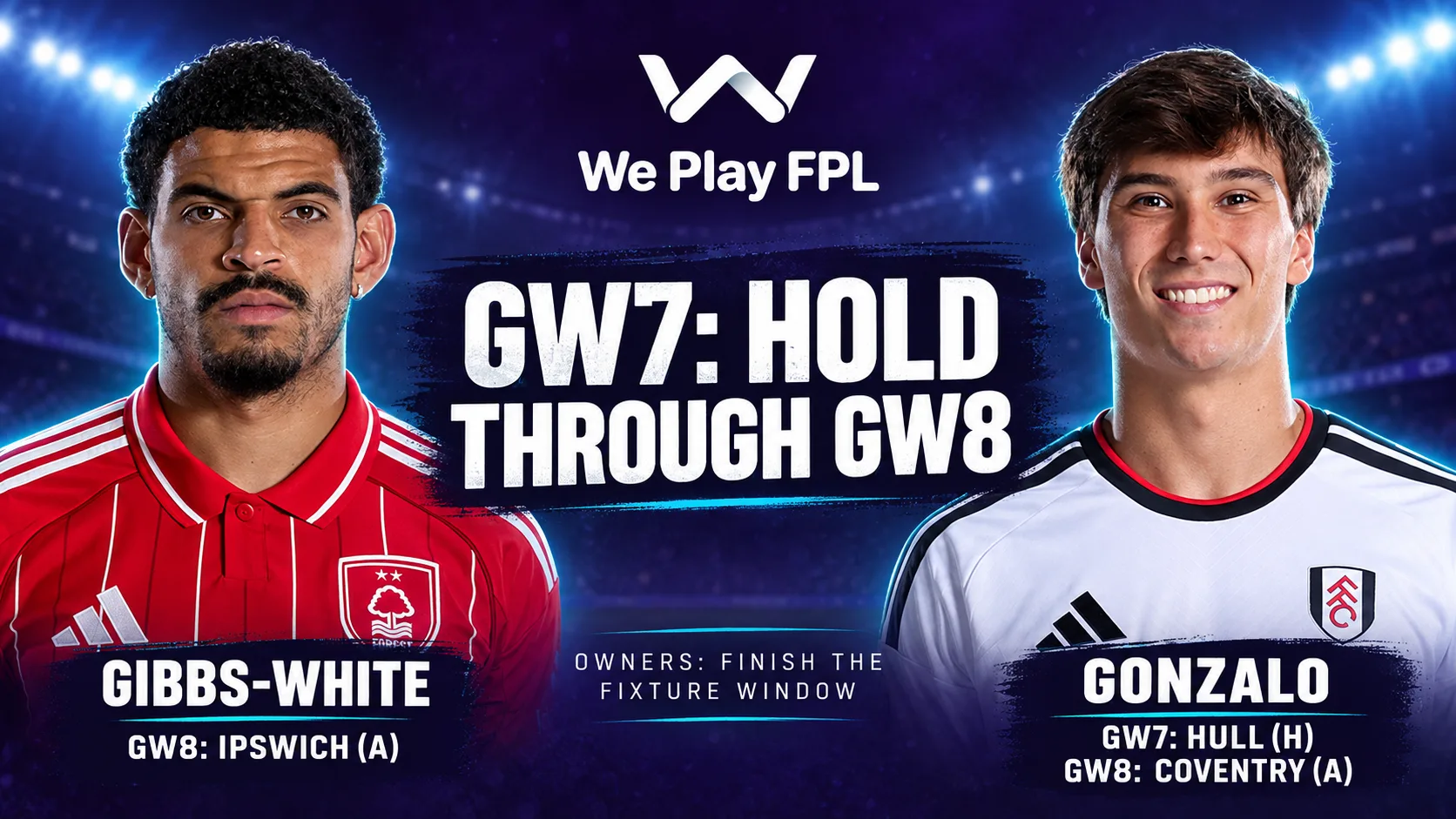
Keep Morgan Gibbs-White, Gonzalo García and Josh King through their remaining short fixture windows if they still fit your squad. You can justify holding all three without making them priorities for a new GW7 transfer.
Owners have a different decision from buyers. You have paid for the move and can collect the next fixtures without spending another transfer. A new buyer needs enough value across the full holding period to justify the cost of getting in and, potentially, getting out.
Keep Gibbs-White for Ipswich, with a GW7 bench option
Gibbs-White faces Arsenal at home in GW7, then Ipswich away in GW8. Keep him for that second match if you can field a stronger alternative against Arsenal. Managers with a weak bench may need to start him, but the difficult immediate fixture makes him a lower priority for a new purchase.
At £8.0m, Gibbs-White has averaged 90 min/match and recorded 0.59 expected goal involvements per 90 minutes, or xGI/90. His playing time gives owners a reason to retain him through Ipswich; the attacking rate supports patience without promising a return.
Plan your exit before buying. Forest then visit Brentford in GW9, host Manchester City in GW10, visit Bournemouth in GW11 and host Chelsea in GW12. A new buyer would commit £8.0m to a player with one appealing near-term target and a demanding run afterwards. Existing owners can finish the Ipswich window and reassess their midfield before GW9.
Give Gonzalo and King the Hull and Coventry matches
Fulham face Hull at home in GW7 and Coventry away in GW8. Keep Gonzalo or King for those matches if you bought them for this run. Selling after the Ipswich blank would remove the two fixtures you still wanted from the original move.
Gonzalo costs £6.1m and occupies a forward slot. He has averaged 85.2 min/match with 0.63 xGI/90. King costs £5.6m and occupies a midfield slot, with 83.3 min/match and 0.41 xGI/90. Gonzalo has offered more expected attacking involvement; King lets you retain Fulham exposure at a lower midfield price.
You can consider either as a two-week purchase if you need to replace an unavailable player. Include the next transfer in your plan: Fulham visit Aston Villa in GW9 and host Newcastle in GW10. Buying for Hull and Coventry makes less sense if you would have to spend another transfer to repair the squad straight afterwards.
Use the We Play FPL planner to map your GW7–10 transfers and compare the line-ups you can field before changing your live team. You can check whether keeping your Fulham player for two matches leaves enough flexibility for the later fixtures.
Compare Calvert-Lewin and Evanilson when you need a forward
Calvert-Lewin and Evanilson both cost £6.0m. Consider them if you have a forward problem to solve; Gonzalo owners can finish the Hull and Coventry window before deciding on a replacement.
Calvert-Lewin has recorded 0.54 xGI/90 while averaging 84.8 min/match. He hosts Manchester United in GW7, visits Sunderland in GW8 and Bournemouth in GW9, then hosts Spurs in GW10. His expected attacking involvement supports the case for a needed move, although managers still depend on him converting chances.
Evanilson has averaged 85.7 min/match with 0.37 xGI/90. Bournemouth host Sunderland in GW7, visit Manchester United in GW8, host Leeds in GW9 and visit Ipswich in GW10. He offers a different sequence for managers who can cover the Manchester United trip and want the later fixtures.
Choose between them using the weeks you need a starter. Calvert-Lewin has the stronger season-to-date attacking rate; Evanilson may suit the fixture gaps in your squad. These expected metrics describe performance so far and do not guarantee future points.
Reassess before the deadline
The GW7 deadline is 17 October at 10:00 UTC, or 13:00 Cairo. Check availability and expected starts before committing a transfer.
For Gibbs-White owners, prepare a GW7 bench option and retain the Ipswich match where your squad allows it. For Gonzalo and King owners, keep the Hull and Coventry window in view. New buyers should compare the full holding period and the next transfer they would need, while managers with an unavailable forward can assess the £6.0m alternatives against their own starting XI.







Differentials
FPL GW5: Tavernier or Dewsbury-Hall for your midfield?
Tavernier offers stronger early attacking numbers at £6.1m. Dewsbury-Hall has the immediate fixtures. Here is how to choose for your squad.

Marcus Tavernier is our preferred attacking pick of these two GW5 midfield options. He costs £6.1m, £0.4m less than Kiernan Dewsbury-Hall, and has produced the stronger early attacking numbers. Dewsbury-Hall’s case rests on Everton’s next two fixtures: Ipswich Town at home and Hull City away.
Choose based on how long you expect to keep the player. If you want an attacking midfielder to own beyond GW6, favour Tavernier, provided your squad can absorb Bournemouth’s difficult opening pair. If you have a midfield vacancy and want to target the next two matches, Dewsbury-Hall deserves consideration. Neither is a reason to dismantle a settled squad.
Tavernier has the stronger attacking start
Across 350 league minutes, Tavernier has recorded 0.44 expected goals per 90 and 0.21 expected assists per 90. His combined expected goal involvement stands at 0.65 per 90. Dewsbury-Hall has played 360 minutes, with 0.16 xG/90, 0.12 xA/90 and 0.28 xGI/90.
The difference extends beyond one route to points. Tavernier has had more expected goal involvement from both shooting and creating chances. At the lower price, he gives you the more appealing attacking profile within this comparison.
Four starts each give us some evidence of early involvement, but only a small performance sample. These season-to-date rates describe the chances each player has had or created; they do not predict his next return. Do not turn Tavernier’s early scoring into an assumed weekly haul.
Everton offer the immediate fixture pair
Dewsbury-Hall faces Ipswich at home in GW5, then visits Hull in GW6. Those fixtures explain why you might accept his higher price and weaker early attacking rates.
That route fits a manager who already has a vacancy and a reason to prioritise the next two Gameweeks. It fits less well if you must spend an extra transfer to raise the money, or expect to remove him after Hull without allowing for the cost of that later move.
Everton host Chelsea in GW7 before away matches against Arsenal and Newcastle. Look at that stretch before buying. If another part of your squad will need attention, a two-match purchase could leave you with a midfielder you planned to sell and a more urgent problem elsewhere.
Bournemouth require patience at the start
Tavernier hosts Liverpool in GW5 and travels to Chelsea in GW6. Buying him now means accepting those opponents in exchange for his attacking profile and lower price.
Bournemouth then host Sunderland in GW7, visit Manchester United in GW8 and host Leeds in GW9. The schedule contains opportunities alongside difficult matches; you should have a reason to keep him through the full period you are assessing.
Use the £0.4m difference in the context of your own squad. You can compare the players and map your next transfers in We Play FPL to see whether the saving improves another position or whether Everton’s immediate fixtures suit your planned line-ups. Check the actual money available after any sale before committing to a pair of moves.
Our GW5 choice
For a fresh purchase with sustained ownership in mind, Tavernier gets our vote from this pair. His stronger shooting and creative rates, combined with the lower price, justify accepting some fixture difficulty if your squad can handle it.
Choose Dewsbury-Hall when your priority is Everton’s GW5–6 pair and the transfer fits without forcing extra spending or an awkward exit. The fixtures make him a credible alternative, but his early attacking numbers give us less reason to stretch the budget for him.
If you already own either player and have a functioning midfield, this comparison alone does not justify a sideways transfer. Assess the likely benefit against the transfer you would give up and your other squad needs.
Recheck availability and midweek workload before the GW5 deadline on Friday 18 September at 17:30 UTC. Prices and statistics above reflect 16 September; all expected metrics cover the 2026/27 league season to date.
Fixtures
FPL GW5 midfield transfers: is Gibbs-White worth selling Szoboszlai?
Weigh Gibbs-White’s Coventry fixture against the £0.9m upgrade from Szoboszlai, then separate Foden’s suspension from Cherki’s minutes risk.
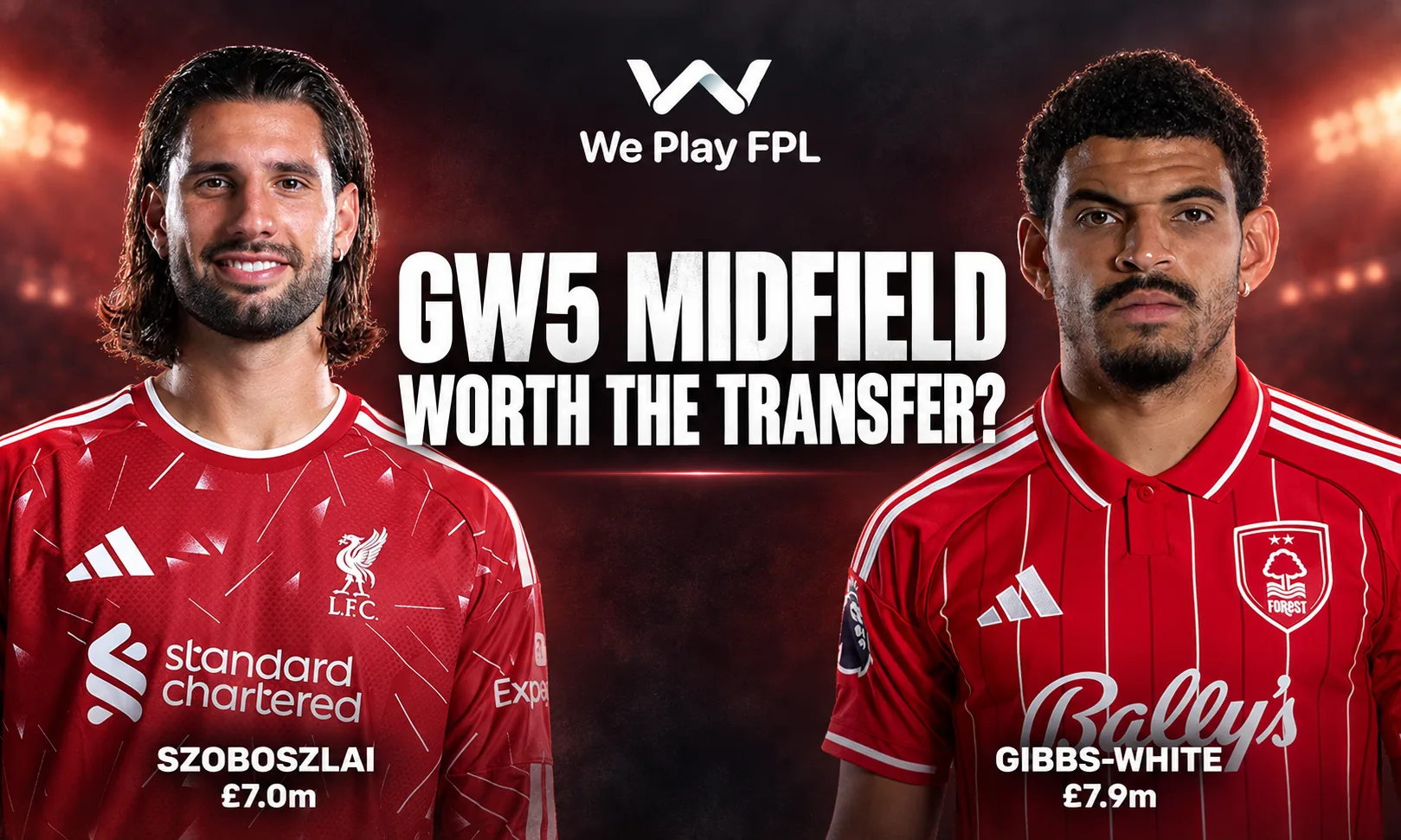
Gibbs-White looks an appealing GW5 purchase for managers with a midfield vacancy. Selling a fit Szoboszlai to buy him takes more thought: you need another £0.9m at current prices and must give up a transfer you could save for a less optional move.
Start by checking who needs to leave your squad. Foden’s suspension puts him ahead of a playable midfielder on the sale list. Cherki owners can take a different approach and hold for Sunderland at home, while accepting some uncertainty over his minutes.
Gibbs-White offers an immediate fixture gain
At £7.9m, Gibbs-White faces Coventry at home in GW5. He has played all 360 league minutes and ranks first in the current penalty order. For a midfielder you need to replace, that combination makes him a strong candidate if you can afford him.
His 0.65 expected goal involvements per 90 minutes, or xGI/90, compares with Szoboszlai’s 0.52 across the same 360-minute sample. Both figures describe 2026/27 performance to date. Neither predicts their next score, and four matches give us limited evidence for a lasting gap.
Look beyond Coventry before committing the extra money. Forest visit Crystal Palace in GW6 and host Arsenal in GW7. You should feel comfortable holding Gibbs-White through that sequence, rather than needing another transfer as soon as the standout home fixture ends.
Szoboszlai owners can keep the transfer
Szoboszlai costs £7.0m and has also played every league minute. He leads Liverpool’s current penalty, direct-free-kick and corner/indirect-free-kick orders. Managers can still expect competition for those duties, but the current hierarchy gives owners reasons to retain him beyond his latest score.
Liverpool visit Bournemouth in GW5, host Manchester City in GW6 and travel to Brentford in GW7. You may prefer Gibbs-White’s immediate fixture, yet that preference alone does not establish that the switch deserves your next transfer.
If your XI works and you have little transfer flexibility, holding Szoboszlai is reasonable. With spare transfers, the £0.9m available and no urgent repair, you can justify the move for the Coventry opportunity.
Before deciding, map the next few Gameweeks in We Play FPL. The planner lets you compare future squad drafts and transfer sequences, so you can see whether spending the extra money now prevents a move you want later.
Foden needs a replacement; Cherki can wait
Foden’s current suspension flag rules him out of GW5. His £7.0m price means a move to Gibbs-White needs the same extra £0.9m, but here you would replace an unavailable player. That is a stronger reason to use the transfer than frustration with Szoboszlai.
Foden has recorded 1.03 xGI/90 over 217 minutes. Those attacking numbers offer no GW5 benefit while he cannot play. Check the suspension status again before confirming a replacement, without assuming an immediate return to the starting XI once he becomes available.
Cherki costs £7.8m and has started City’s last three league matches. He played 45 minutes in GW4, when City lost Foden to a red card after 22 minutes. Treat that unusual match context with care before judging Cherki’s next start.
His 0.82 xGI/90 over 218 minutes supports patience for Sunderland at home. Foden’s absence could improve Cherki’s opportunity, although it guarantees neither a start nor a full match. Holding him for GW5 is a reasonable call; reassess after the next game, with Liverpool away to follow.
GW4 remains in progress as of 14 September. The GW5 deadline is 18 September at 17:30 UTC. Review the remaining matches, midweek selection and late team news before committing: Foden owners have a concrete availability problem, while Szoboszlai and Cherki owners have room to wait.
Chip Strategy
FPL GW4 selection: O’Reilly returns, Dedić doubt and Groß’s role
Reassess O’Reilly after his return, pause Dedić purchases through the hamstring doubt, and weigh Groß’s minutes and set pieces for Coventry away.
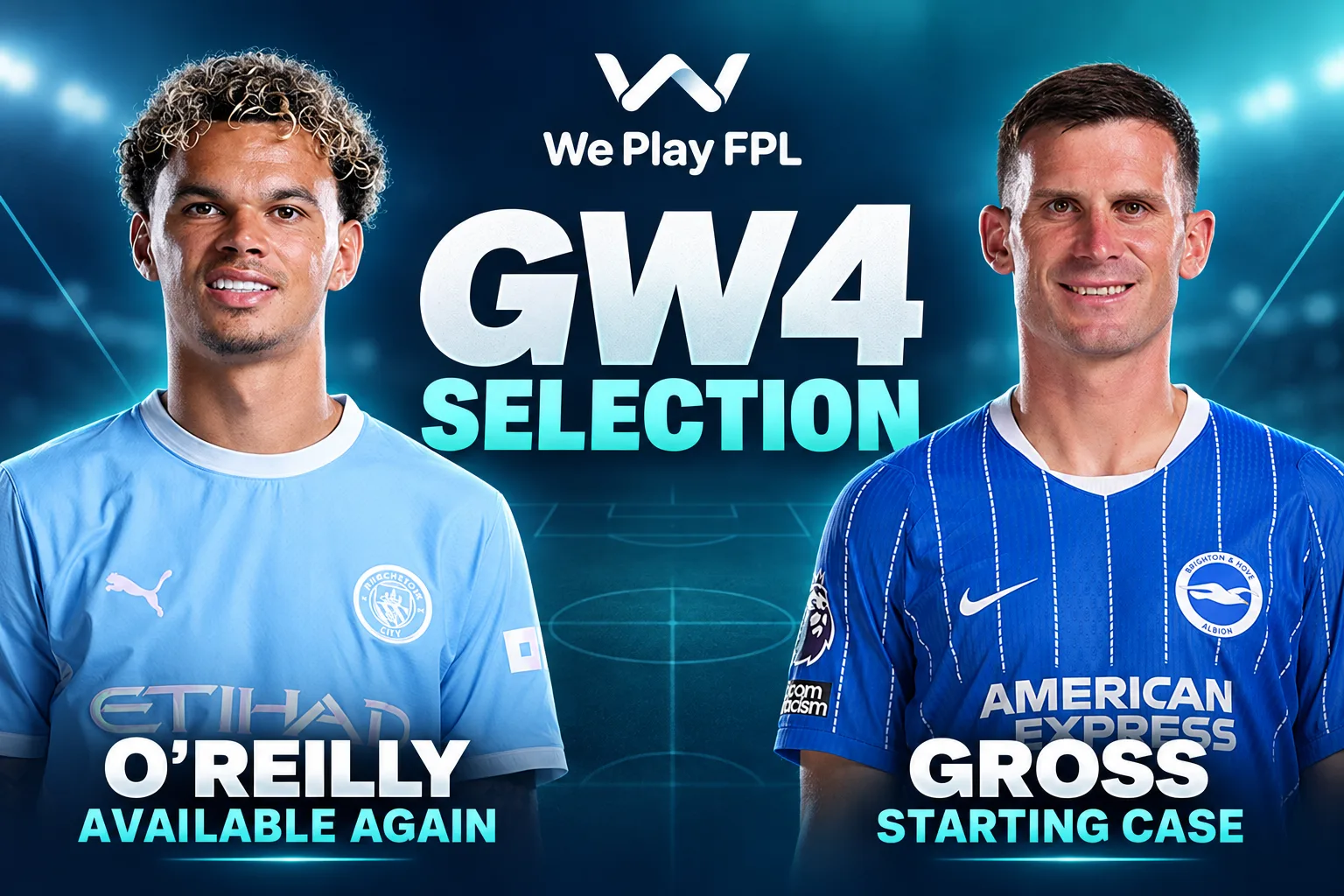
O’Reilly owners can put him back into their GW4 selection plans. Dedić buyers should wait for clarity on his hamstring. If you own Groß and face a close benching decision, his minutes and set-piece role deserve a closer look before Coventry away.
Those are three different calls: whether to restore a fit defender, whether to buy a doubtful one, and whether to start a midfielder you own. Make each decision before the GW4 deadline on Saturday 12 September at 12:30 UTC.
O’Reilly: reconsider the bench decision
O’Reilly is available again. If you had benched him because of his back injury, reassess that choice rather than carrying it into the deadline unchanged.
At £6.4m, the Manchester City defender has played 150 league minutes across two starts. His early rates are 0.73 expected goals conceded per 90 (xGC/90) and 0.31 expected goal involvements per 90 (xGI/90). Those numbers give you a defensive and attacking basis for the selection discussion, but 150 minutes remains a small sample. They describe his performances so far, not a forecast for the derby.
City visit Manchester United in GW4, then host Sunderland in GW5. You can retain O’Reilly without deciding that he must start this weekend. Compare him with the defender who would take his place: the opponent, attacking involvement and likely minutes all matter.
Availability removes the injury obstacle. It does not confirm a start or a full match. Owners should check the latest team news and revise their XI if they have stronger evidence about his role. New buyers need that same check before committing £6.4m.
Dedić: hold off on a new purchase
Dedić costs £4.5m, but he still carries a hamstring doubt ahead of Newcastle’s trip to Leeds. Pause a new purchase while that remains unresolved. A budget defender offers little immediate help if you need him to fill a starting slot and cannot establish whether he will play.
He has completed all 270 league minutes through GW3, with 1.82 xGC/90 and 0.08 xGI/90. His previous playing time supports his role before the injury; it cannot settle his fitness for the next match. The 75% availability flag also does not provide a measured probability that he will start.
Existing owners face a different choice. If you have a fit reserve you would accept in your XI, you can wait for clearer news before spending a transfer. If you lack cover, resolving that gap matters more than preserving the original purchase decision. Recheck the hamstring update before choosing between those routes.
Newcastle host Hull in GW5 and visit Coventry in GW6. Those fixtures give you a reason to revisit Dedić once his availability improves, rather than buying through the doubt to secure this week’s price. Keep his health as the condition for that reassessment.
Groß: give the role its weight
Groß deserves consideration for your starting XI at Coventry. Brighton’s £5.6m midfielder has played all 270 league minutes and sits first in the current penalty, direct-free-kick and corner/indirect-free-kick orders.
He has produced 0.28 xG/90 and 0.14 xA/90, combining for 0.42 xGI/90. These season-to-date rates cover three matches. You should not expect a return just because he has several ways to create one, but those routes strengthen his case in a close selection call.
If your alternative relies on uncertain minutes or a single route to points, lean towards Groß. If that alternative has a stronger attacking role and dependable playing time, compare the pair on those merits. His modest price should not decide which player sits on your bench.
You can compare the players in We Play FPL using performance data and upcoming fixtures before settling that final midfield place. Use projections as an aid to the decision; they cannot guarantee the outcome.
This is a GW4 starting case for owners. Brighton host Arsenal in GW5 before visiting Sunderland in GW6, so a fresh purchase needs a plan beyond Coventry. Set-piece duties can also change, and three complete matches do not guarantee a fourth.
Before the deadline, revisit O’Reilly’s likely involvement and Dedić’s injury news. For Groß, decide whether the alternative on your bench has a better combination of minutes and scoring opportunities. You may improve your XI through those selection choices without buying anyone.