Everton
Liverpool Survive Derby Scare to Stay Perfect After 2-1 Win Over Everton
Liverpool beat Everton 2-1 in the Merseyside derby to extend their lead and keep a perfect start too.


Liverpool extended their early-season run with a 2-1 Merseyside derby victory, holding off a spirited second-half response from Everton to preserve a perfect start to the campaign. Everton reduced the deficit through Idrissa Gueye, but Liverpool clung to their narrow advantage until the final whistle.
First, the result underlined both resilience and recurring vulnerability. Liverpool have needed goals in the 83rd minute or beyond to win all five of their competitive matches this season, yet this derby was settled by two first-half strikes. That said, the Reds have surrendered two-goal leads on three separate occasions this season and they threatened another collapse after the break. Questions over concentration and defensive organisation will persist, but a sixth straight win remains a noteworthy achievement and keeps them clear at the summit of the Premier League.
Second, Ryan Gravenberch’s shift into a deeper role continues to pay dividends. His transformation into a defensive midfielder was crucial to Liverpool’s Premier League title triumph last season, and he is building on that form in Arne Slot’s double pivot. Gravenberch produced a sumptuous finish in the derby and earlier starred in the midweek victory over Atlético Madrid with an all-action display. He supplied an assist for Mohamed Salah’s effort at Anfield and earned another assist when his through ball was fired home by Ekitiké. The Netherlands international managed just four assists last season, yet has already produced four goal contributions in six matches this term, adding valuable balance to Liverpool’s engine room.
Third, the forward options are showing encouraging depth. All eyes were lasered on Alexander Isak midweek as the record Premier League signing made his Liverpool debut. There were encouraging signs during his hour-long outing against Atléti, particularly after he missed the entirety of pre-season due to his self-imposed exile at Newcastle United. Meanwhile Ekitiké continued his excellent start to life in English football with a well-taken strike in the derby. The Frenchman now has four Liverpool goals including his effort in the Community Shield and contributed strongly in both attack and defence during his appearance.




Arsenal
From £75-a-week to millions: Rooney’s scholar pay compared with Max Dowman
Rooney earned the equivalent of $100 weekly as a scholar; Max Dowman can earn $465.60 now per rules.
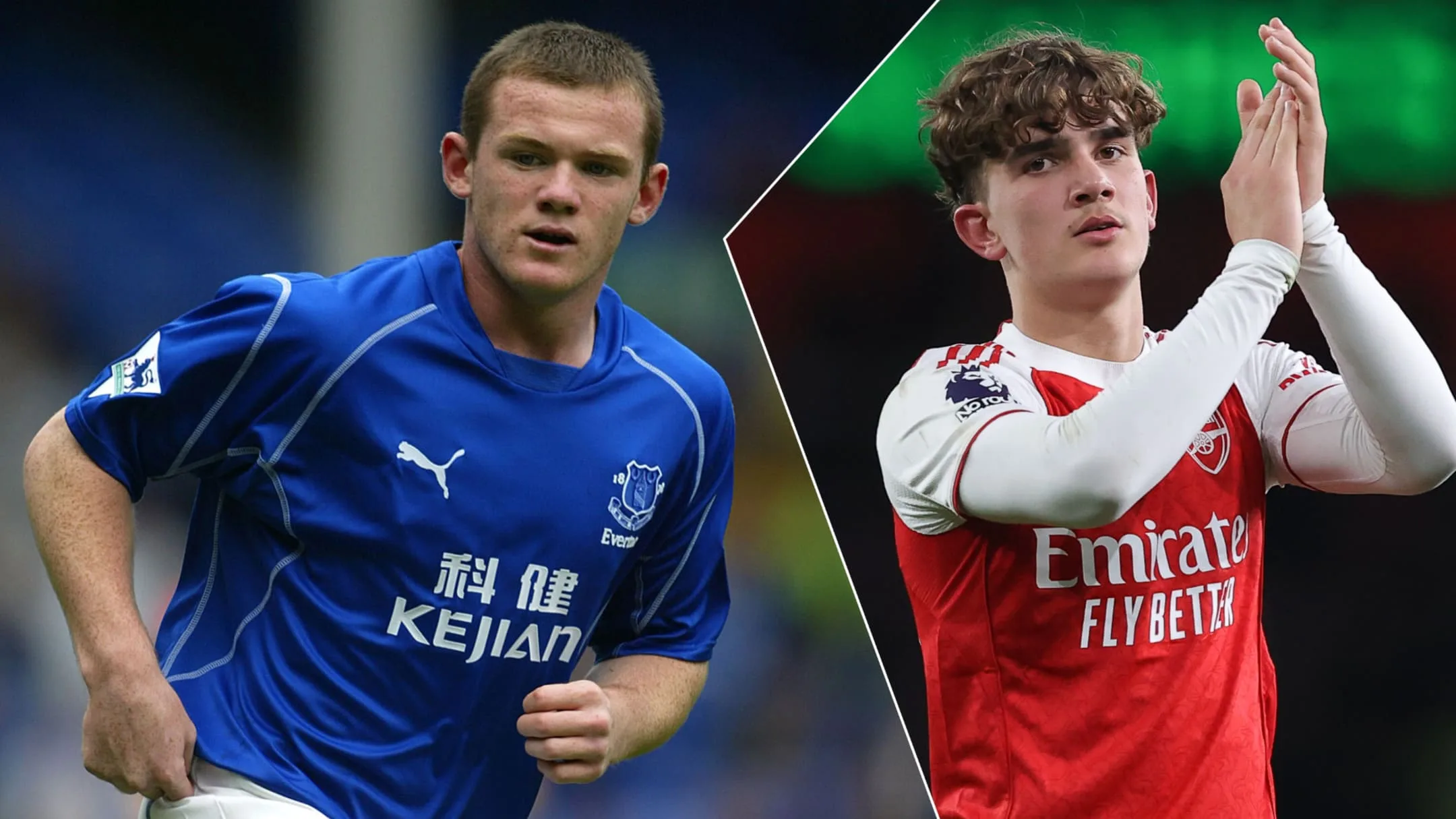
Wayne Rooney’s early earnings as a scholar remain a striking reminder of how quickly a football career can change financially. Rooney has revealed he was receiving the equivalent of just $100 each week when he scored the famous goal against Arsenal in 2002. That payment came while he was still a scholar, four days shy of his 17th birthday.
The landscape for under-17 players is defined by rules that keep them on scholar terms until they are eligible to sign professional contracts. The recent emergence of Max Dowman, who scored for Arsenal against Everton 73 days after his 16th birthday, has brought those scholar payments back into focus. Dowman can earn up to $465.60 per week under current terms, an annual figure of $24,211.
Rooney recalled the difference between those scholar payments and professional wages on his BBC podcast. “When I scored against Arsenal, I think I was on £75 ($100)-a-week,” he said. “But then that was four days before my 17th birthday, so I was still a scholar [for the Arsenal game]. I used to borrow money off my mum and dad until I signed my pro contract.” The transition at 17 is decisive: a contemporary newspaper report noted that, upon signing his first professional contract, Rooney jumped to a weekly salary of $17,293 (at today’s rate), an amount that worked out at almost $900,000 a year.
The progression continued rapidly. By the time Rooney left Everton and joined Manchester United aged 18, he was being paid not far short of $3.5 million per season. Those figures underline the contrast between scholar allowances and professional terms, and they also reflect Rooney’s own modest upbringing. He admitted he used to exaggerate travel distances when reporting for England’s national youth teams. “I used to find the furthest place away and say that’s where we drove in from,” he laughed.
Chelsea
Three Standouts from Gameweek 29: Palmer, Wharton and Garner
Gameweek 29 standouts Cole Palmer, Adam Wharton and James Garner impressed in Premier League action.

Shock results dominated the midweek slate, none more notable than Wolverhampton Wanderers’s last-gasp win over Liverpool. The round was less chaotic than the weekend, but several individual displays caught the eye of statisticians at FotMob.
Cole Palmer (Rating: 8.6) was central to Chelsea’s response in the Midlands. Chelsea had looked likely to suffer a fourth Premier League match without victory after conceding early at Aston Villa, but they recovered to secure a 4–1 win and capitalise on slips from Liverpool and Man Utd in the race for Champions League qualification. As he’s so often been at Chelsea’s best, Cole Palmer was integral to an important win in the Midlands. The attacking midfielder returned to the scoresheet as he rattled beyond Emi Martínez for his side’s third of the evening, a rare non-penalty goal these days, and his general play laid the foundations for an impressive attacking display.
Adam Wharton (Rating: 8.6) returned to form for Crystal Palace as the Eagles recorded a significant 3–1 away victory at London rivals Tottenham Hotspur. Wharton offered a composed head amid a frenetic end to the first half, supplying two assists to complete Palace’s quick-fire comeback. The first was a simple pass to Jørgen Strand Larsen but the second was a sumptuous through ball poked home by two-goal Ismaïla Sarr.
James Garner (Rating: 8.7) continued a quietly excellent season in Everton’s midfield during their 2–0 win over Burnley. Garner’s set-piece quality provided the opening goal; a teasing free kick delivery to the far post led to James Tarkowski’s opener. He finished the game with more touches than anybody else on the pitch and a match-high 13 defensive contributions, underscoring how influential he has been in Everton’s engine room this campaign.
These three performances were among the brightest in Gameweek 29, each combining tangible statistical impact with decisive moments that helped their teams on the night.
Aston Villa
Premier League: Accounts Show PSR Compliance After Women’s Team Sales
All 20 Premier League clubs met PSR for 2024-25 as women’s-team sales shaped reported accounts. PSR.

All 20 Premier League clubs are reported to have satisfied Profit and Sustainability Rules (PSR) for the 2024–25 season, with a number of clubs using asset sales to parent companies to record revenue in their accounts.
Everton and Aston Villa are understood to have benefited from the sales of their women’s teams to parent companies, following Chelsea’s decision to do so in June 2024. Premier League rules permit the use of such sales when recording revenue, while UEFA does not allow them.
Aston Villa’s £55 million ($74.2 million) sale of their women’s team to their parent company is credited with helping the club avoid Premier League breaches. That transfer is not understood to have the same effect under UEFA’s financial regime. Unai Emery’s side are said to have broken UEFA’s squad cost rule, which restricts spending on player wages, transfers and agent fees to 70% of revenue.
Villa’s dispute with the squad cost rule has been ongoing. The club were fined £5.2 million last summer and another failure to meet UEFA requirements is expected to bring further financial punishment.
PSR regulations have become increasingly unpopular since their introduction in 2025, with the use of loopholes such as the sale of women’s teams and other club assets cited as factors that have eroded confidence in the system. As a result, Premier League officials are pursuing changes to the rules, with squad cost regulations among the areas under review.
England’s top flight will initially adopt a softer approach by restricting spending to 85% of revenue. Villa’s first breach of UEFA’s squad cost rule last summer occurred when the governing body’s limit was set at 80%. Discussions have also been held over a process known as “anchoring.” The reported accounts and the proposed reforms signal an active season of regulatory review and potential change within English top-flight governance.